AI estimate as of September 23, 2025 · verify with a professional before acting
AI-Generated · Verify before acting
Everything on this page is generated by AI for informational purposes only. AI can make mistakes — the AI may misidentify items or misattribute them (artist, maker, brand, designer, origin, era). This is not an official valuation and should not be used for insurance, sale, tax, estate, legal, or lending purposes — or any decision requiring a certified appraisal. It is not an authoritative claim about any person, brand, or rights holder — do not share or rely on it as a factual statement about a third party. Always consult qualified professionals before making financial decisions.
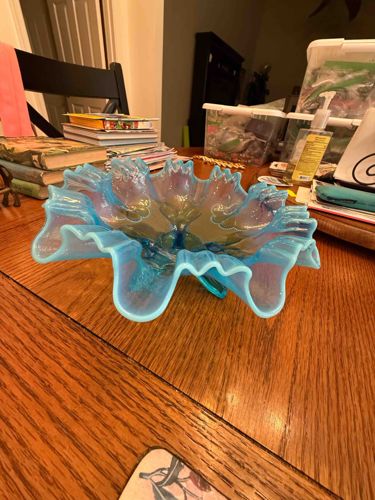
This item is an iridescent blue glass ruffled bowl, likely serving as a decorative centerpiece, fruit bowl, or catch-all dish. The bowl is crafted from translucent glass with a dominant light blue hue, which exhibits a strong iridescent effect, causing it to shimmer with subtle shifts in color, including hints of yellow, pink, and purple, particularly visible in the central and upper ruffled areas. The form of the bowl is distinctly floral or organic, featuring numerous deep ruffles around its entire circumference, giving it a petal-like appearance. These ruffles vary in depth and curvature, creating an undulating rim and sides. The base of the bowl appears relatively small and stable, providing support for the wide, open form. The construction seems to be molded glass, possibly hand-finished to achieve the intricate ruffles. There are no visible chips, cracks, or significant damage from the provided images, suggesting it is in good overall condition. The iridescent finish appears intact, which is an important factor in preserving its aesthetic appeal. While no specific maker's marks or signatures are discernible, the style suggests it could be a piece of art glass from the mid-20th century to contemporary period, with designs reminiscent of Fenton Art Glass or similar art glass manufacturers known for their iridescent finishes and ruffled forms. The craftsmanship, particularly the consistency of the ruffles and the application of the iridescent coating, appears to be of good quality.
AI Appraisal Report
Upon visual examination of the provided images, this iridescent blue glass ruffled bowl appears to be in excellent condition. There are no visible chips, cracks, or significant abrasions, and the iridescent finish seems fully intact, which is crucial for its aesthetic and value. The craftsmanship, particularly the consistent ruffling and application of iridescence, suggests a piece of good quality molded art glass. Given its style, it likely dates from the mid-20th century to the contemporary period, possibly inspired by manufacturers like Fenton Art Glass.
Market conditions for decorative iridescent glass bowls from this era are generally stable, with a moderate demand among collectors of art glass and interior decorators. Comparable items from lesser-known or unmarked manufacturers typically retail in the $60-$150 range, depending on size, complexity of form, and color vibrancy. The strong iridescent effect and elaborate ruffling add to its appeal. While not exceptionally rare, pieces in pristine condition with attractive coloration like this one tend to hold their value well.
Factors impacting value include its excellent condition and appealing design. However, the absence of a discernible maker's mark significantly limits its upper valuation. Provenance documentation, if available, could link it to a specific, more desirable manufacturer, significantly increasing its value. Without physical inspection, I cannot verify the exact method of manufacture (e.g., hand-finished vs. purely molded), nor can I definitively rule out minute imperfections not visible in images. A physical examination could confirm its weight, glass quality, and disclose any hidden markings or faint damage. Scientific testing is not typically required for items of this nature unless there's an authenticity dispute regarding very high-value pieces.