AI estimate as of September 28, 2025 · verify with a professional before acting
AI-Generated · Verify before acting
Everything on this page is generated by AI for informational purposes only. AI can make mistakes — the AI may misidentify items or misattribute them (artist, maker, brand, designer, origin, era). This is not an official valuation and should not be used for insurance, sale, tax, estate, legal, or lending purposes — or any decision requiring a certified appraisal. It is not an authoritative claim about any person, brand, or rights holder — do not share or rely on it as a factual statement about a third party. Always consult qualified professionals before making financial decisions.
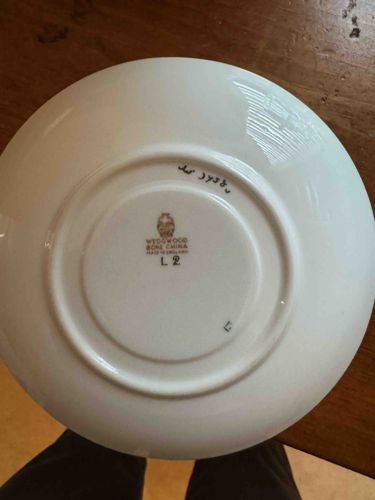
This item is a white bone china saucer, likely part of a teacup or coffee cup set, manufactured by Wedgwood. The reverse side, visible in the image, clearly displays the iconic Wedgwood urn mark in a reddish-brown or sepia tone, encircled by the text 'WEDGWOOD' above and 'BONE CHINA' and 'MADE IN ENGLAND' below. This mark indicates it is a genuine Wedgwood product made from high-quality bone china, known for its strength, translucency, and elegant appearance. Below the main mark, the characters 'L2' are printed, which could denote a pattern number, production batch, or specific mold. Further out from the center, a handwritten mark in black ink is visible, appearing to read 'dr 3738u,' which may be an inventory number, a personal identification mark, or a collector's notation. Additionally, a faint, almost illegible single character, possibly an 'F' or a similar letter, is present near the rim, which could be a quality control mark or another internal factory notation. The saucer exhibits a smooth, glossy glaze without any apparent cracks, chips, or significant crazing, suggesting good preservation. There are some minor surface scratches visible in certain light conditions, particularly near the handwritten mark, which are consistent with typical handling and age, but do not detract significantly from its overall appearance. The construction indicates a traditional, circular form with a slightly raised central well designed to steady a cup, and a gently curving rim. The material's inherent whiteness and the precise printing of the manufacturer's mark suggest a good level of craftsmanship. Based on the 'MADE IN ENGLAND' notation and the style of the mark, it likely dates from the mid-20th century or later.
AI Appraisal Report
Based on my visual examination of the provided image, I can confirm this is a genuine Wedgwood Bone China saucer, indicated by the iconic urn mark with 'WEDGWOOD', 'BONE CHINA', and 'MADE IN ENGLAND'. The condition appears good from the photo; the glaze is smooth, and there are no obvious chips, cracks, or significant crazing visible. Minor surface scratches are consistent with age and typical use and do not materially devalue the item. The 'L2' and 'dr 3738u' markings are likely internal factory codes or inventory numbers, while the faint 'F' could be a quality control stamp. These marks are not typically associated with rare or highly sought-after patterns, nor do they signify any special edition.
Market conditions for individual Wedgwood saucers without their accompanying cup or as part of an incomplete set are generally modest. Comparables for common Wedgwood bone china saucers from the mid-20th century to later, in good condition, typically range from a few dollars to about fifteen dollars. There is no indication of exceptional rarity or high demand for this specific piece or pattern. Factors impacting value negatively include it being a single saucer, lacking its cup, and not being part of a full set. The handwritten mark 'dr 3738u', while potentially a collector's note, does not enhance value unless it signifies provenance from a notable collection, which cannot be determined from the image.
It is important to note that this assessment is based solely on visual examination of the image. A physical inspection would be necessary to verify the complete absence of hairline cracks, subtle crazing, or repairs, as well as to fully interpret the handwritten mark. Provenance documentation or scientific testing would be required to authenticate the origin of the handwritten mark or confirm the specific production date with absolute certainty.