AI estimate as of August 16, 2025 · verify with a professional before acting
AI-Generated · Verify before acting
Everything on this page is generated by AI for informational purposes only. AI can make mistakes — the AI may misidentify items or misattribute them (artist, maker, brand, designer, origin, era). This is not an official valuation and should not be used for insurance, sale, tax, estate, legal, or lending purposes — or any decision requiring a certified appraisal. It is not an authoritative claim about any person, brand, or rights holder — do not share or rely on it as a factual statement about a third party. Always consult qualified professionals before making financial decisions.
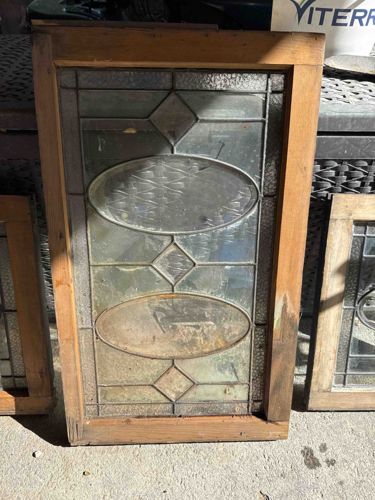
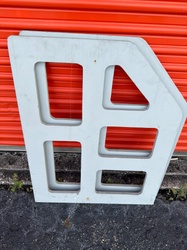
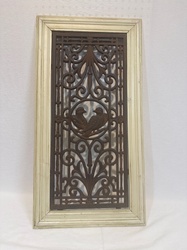
This item is a rectangular stained-glass window panel set within a rustic wooden frame, likely salvaged from an older building. The physical characteristics indicate a frame constructed of light-colored, possibly oak or pine, wood with visible grain patterns. The wood appears unfinished or stripped, showing signs of natural aging, including discoloration, some dark staining, and minor abrasions indicative of wear and tear. The overall dimensions are substantial, suggesting it could have been part of a larger door, transom, or side-light assembly. The stained-glass design features a geometric pattern with clear, textured, and possibly subtly tinted glass sections. There are two prominent oval-shaped clear glass inserts, one in the upper-middle and one in the lower-middle, flanked by smaller rectangular and diamond-shaped panes. Some of these smaller panes exhibit a rippled or textured surface typical of older architectural glass. The glass is held together by lead came, which shows a dark patina consistent with age. Notable features include the symmetrical arrangement of the glass elements and the contrast between the clear and textured glass. Visible condition issues include significant hazing and surface residue on the clear oval panels, suggesting exposure to moisture or neglect. Some of the lead came appears slightly bent or distorted in places, and sections of the wooden frame show splits or separation at the corners, requiring potential repair. The overall aesthetic points to an early 20th-century style, possibly Arts and Crafts or a simpler Victorian design, though without maker's marks or specific historical context, a precise age is difficult to determine. The craftsmanship appears competent for its utilitarian purpose, demonstrating good leading work for its period, though the wood frame's finish is no longer pristine. The condition suggests it is an antique or vintage piece, valuable primarily for its salvageable components and potential for restoration.
AI Appraisal Report
Based on my visual examination of the provided image, this Vintage Stained Glass Window Panel presents as an authentic architectural salvage piece, likely dating from the early 20th century, consistent with Arts and Crafts or simpler Victorian styles. The visible lead came construction, textured glass, and geometric design support its age claim, though definitive authentication of origin or precise age from an image alone is limited without maker's marks or provenance. Physical inspection would allow me to confirm glass types, assess lead integrity, and detect repairs.
Condition is fair, exhibiting significant wear consistent with an object salvaged from a building. The wooden frame shows significant aging, dark staining, and minor abrasions, with splits/separation at corners. The glass itself appears stable, but the clear oval panels show notable hazing/surface residue, suggesting environmental exposure or neglect. The lead came exhibits a dark patina and some minor distortion.
Market conditions for architectural salvage items like this are generally stable, with demand driven by renovation projects, period-specific design preferences, and artistic reuse. Comparables for unrestored, good-sized geometric panels in a wooden frame typically range from $300-$700. Factors significantly impacting value here include its substantial size and the potential for restoration. Conversely, the need for professional restoration of the glass hazing and frame repair considerably detracts from its 'as-is' value.
This piece is not particularly rare given the period's production volume, but its specific design and dimensions may appeal to a niche buyer. Its value lies primarily in its salvageable components and restoration potential.