AI estimate as of August 3, 2025 · verify with a professional before acting
AI-Generated · Verify before acting
Everything on this page is generated by AI for informational purposes only. AI can make mistakes — the AI may misidentify items or misattribute them (artist, maker, brand, designer, origin, era). This is not an official valuation and should not be used for insurance, sale, tax, estate, legal, or lending purposes — or any decision requiring a certified appraisal. It is not an authoritative claim about any person, brand, or rights holder — do not share or rely on it as a factual statement about a third party. Always consult qualified professionals before making financial decisions.
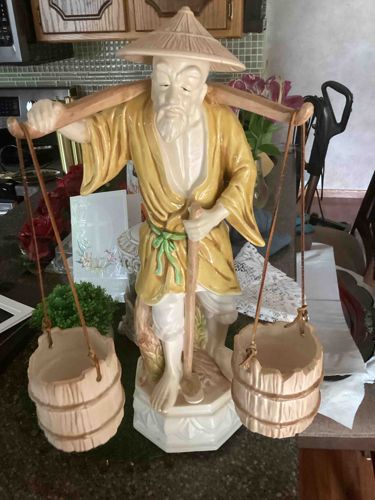
This is a ceramic or porcelain figurine depicting an East Asian-style male figure, likely an elderly man or a 'Coolie', carrying two buckets or planters on a shoulder pole. The figure is rendered in a traditional, possibly somewhat stylized, manner. The primary colors include a pale cream or ivory for the skin, a rich golden yellow for the robe, and light green for a sash or belt. The shoulder pole and staff are depicted in a natural wood-like brown. The hat is a wide-brimmed conical shape, common in East Asian agricultural or working attire, and is also in a cream or light natural tone, with incised lines suggesting woven straw. The two buckets suspended from the shoulder pole are textured and painted to resemble wooden barrels, suggesting a rustic aesthetic. The figure's face shows an aged appearance with a long, white beard and mustache, closed or downcast eyes, and a serene or pensive expression. He holds a staff or walking stick in his right hand. The base of the figurine is an octagonal shape, in the same pale cream color, with molded or sculpted decorative elements around its perimeter. The overall finish appears to be a glossy glaze. There are no immediately obvious signs of chips, cracks, or significant damage from the provided image, suggesting good to very good visible condition. The craftsmanship appears to be of decent quality, with attention to detail in the facial features, clothing folds, and the texture of the 'wooden' elements. The style strongly suggests an origin inspired by East Asian culture, possibly a Japanese or Chinese motif, commonly seen in decorative arts from the mid-20th century onwards. The item functions as a decorative piece, likely intended for display on a shelf, mantel, or table. Its size appears substantial enough to be a prominent display item. No clear manufacturer's marks or signatures are visible in the provided image.
AI Appraisal Report
Upon visual examination of the provided image, this East Asian-style figurine, depicting a figure with a shoulder pole and buckets, appears to be in very good to excellent visible condition. There are no obvious chips, cracks, or significant wear apparent from the photograph, and the glossy glaze finish is consistent across the piece. The craftsmanship, particularly the facial details, textured elements, and color application, suggests a decorative ceramic or porcelain piece likely mass-produced or semi-mass-produced from the mid-20th century onwards, possibly Japanese or Chinese in origin, designed for ornamental display.
Authenticity: Based solely on the image, I assess this as a decorative item, not an antique of significant historical or artistic value. The lack of visible maker's marks or signatures, while common for such decorative pieces, limits definitive authentication of origin or specific manufacturer without in-person examination. For full authentication and to ascertain precise manufacturing details or origin, a physical inspection would be crucial to examine the base for impressed marks, the quality of the paste, and the firing characteristics. Provenance documentation, if available, would also be invaluable.
Market Conditions & Comparables: The market for mass-produced East Asian-style decorative figurines is relatively broad, with a wide range of pricing depending on size, detail, age, and maker. While charming, pieces like this generally fall into the decorative rather than fine art category. Demand is moderate, driven primarily by collectors of specific styles or general home décor. Rarity is low; similar figures are commonly found in secondary markets. Factors impacting value include its good condition and pleasing aesthetic, offset by its probable mass-produced nature and absence of a known maker. Its primary value is decorative.
In-person examination would involve checking for hidden damage, assessing weight and material quality more accurately, and thoroughly searching for any obscured markings or artist signatures that could raise its value. Without this, and based on what is visible, its value is primarily decorative.