AI Appraisal Estimate

AI-generated estimates · not official valuations

From the user

What was submitted

Photo and notes provided by the user — not generated by AI

Submitted item photo
Submitted photo · June 15, 2026

User's notes

No additional notes provided.

AI analysis below

AI appraisal

AI analysis & estimate

AI-Generated · Verify before acting

Everything below is generated by AI for informational purposes only. AI can make mistakes — the AI may misidentify items or misattribute them (artist, maker, brand, designer, origin, era). This is not an official valuation and should not be used for insurance, sale, tax, estate, legal, or lending purposes — or any decision requiring a certified appraisal. It is not an authoritative claim about any person, brand, or rights holder — do not share or rely on it as a factual statement about a third party. Always consult qualified professionals before making financial decisions.

Read the full disclaimer

AI Identification

·Not independently authenticated·Verify before acting

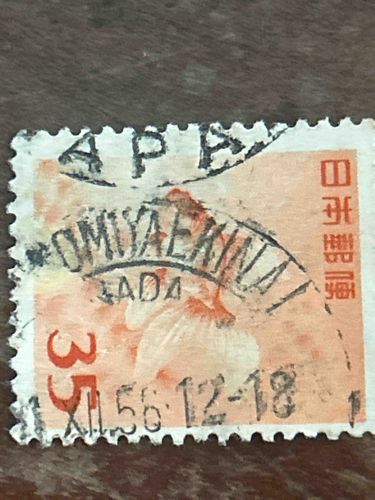
Japanese 35-Yen Sasanqua Camellia Definitive Stamp

Philately / Postage Stamps

AI Estimated Value

·Not an official valuation·Verify before acting

$0.05 - $0.25

As of June 15, 2026

AI Item Analysis

·AI can make mistakes·Verify before acting
This is a used Japanese definitive postage stamp featuring a Sasanqua Camellia flower. The stamp is printed in a light orange-vermilion monochromatic shade on white paper. The denomination '35' is clearly visible in red ink at the bottom-left corner, and the Kanji characters for 'Nippon Yubin' (Japan Post) are vertically oriented along the right margin. The stamp features standard line perforations on all four sides. A significant portion of the image is obscured by a black circular date stamp (CDS) from a post office. The cancellation mark includes Latin alphabetic text, specifically 'OMIYAEKIMAI' and 'JAPAN', which indicates it was processed at a post office near the Omiya Railway Station. The date on the cancellation is '56.12.18', representing the Showa era year 56 (1981), December 18th. The stamp shows typical signs of postal use, including light staining or 'toning' on the surface, ink smudging from the heavy cancellation, and slightly irregular edges on the perforations. This specific design was part of a definitive series in use during the late 1970s and early 1980s. The paper appears to be standard non-phosphor stock typical of the era. The heavy cancellation reduces its value to philatelists interested in mint condition, but the clear date and location mark add historical context for postal history collectors.

AI Appraisal Report

·AI can make mistakes·Verify before acting
I have examined the digital representation of this 1980-vintage 35-Yen Sasanqua Camellia definitive stamp. My assessment identifies this as a standard-issue Japanese postage stamp (Scott #1355) from the late 20th century. The item appears authentic based on the typography of the '35' denomination and the characteristic vermilion-orange ink typical of Japan's Showa-era printing. The 'OMIYAEKIMAI' (Omiya Railway Station) cancellation dated December 18, 1981, is clear, but the ink is heavy, significantly obscuring the central floral motif. From a philatelic perspective, this stamp is extremely common. Billions of definitive stamps in this series were produced for domestic use. The condition is assessed as 'Used, Fine' with typical toning and standard perforation wear. While the cancellation is a legible 'Circular Date Stamp' (CDS) favored by postal history enthusiasts, it does not carry a premium as Omiya was a high-volume hub. Similar specimens sell in bulk lots where the individual value is negligible, usually less than $0.10. Market demand for used modern Japanese definitives is currently very low, as supply vastly outweighs collector interest. The heavy cancellation, while providing historical context, further detracts from its aesthetic appeal for thematic camellia collectors. Limitations: Verification from an image cannot confirm paper weight, gum remnants, or the presence of microscopic repairs or cleaning. A physical inspection under UV light would be required to rule out chemical alterations, and a micrometer would verify perforation gauge accuracy. For an item of such low market value, professional certification or provenance documentation is generally not sought or required.

Get your items appraised

Instant estimates of your treasures with AI-powered appraisals

Browse More Appraisals