AI estimate as of September 1, 2025 · verify with a professional before acting
AI-Generated · Verify before acting
Everything on this page is generated by AI for informational purposes only. AI can make mistakes — the AI may misidentify items or misattribute them (artist, maker, brand, designer, origin, era). This is not an official valuation and should not be used for insurance, sale, tax, estate, legal, or lending purposes — or any decision requiring a certified appraisal. It is not an authoritative claim about any person, brand, or rights holder — do not share or rely on it as a factual statement about a third party. Always consult qualified professionals before making financial decisions.
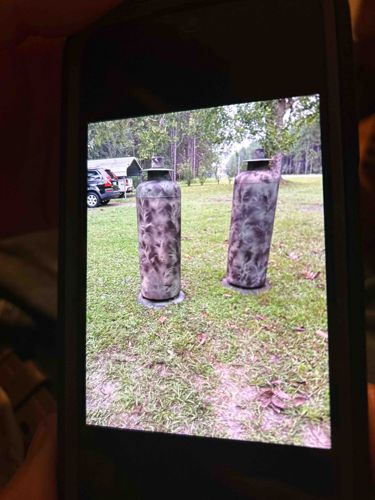
The image displays two large, cylindrical objects, likely constructed from a metal such as steel, given their robust appearance and common material for such industrial-looking pieces. They appear to be repurposed or decorative items, possibly old propane or industrial gas tanks, converted into yard art or architectural elements. Each cylinder stands upright, seemingly anchored into the ground on individual circular bases. The dominant feature is their heavily distressed and mottled surface, exhibiting a complex, variegated pattern of charcoal grey, lighter grey, and hints of brown or rust tones, suggesting significant exposure to the elements or an intentionally applied antiqued finish. This 'marbled' or 'cloudy' patination covers the entire visible body of the cylinders. At the top of each cylinder, there is a distinct, black, flat-top cap, possibly original valve covers or added decorative elements. The overall height of each object appears to be significant, possibly ranging from 4 to 6 feet, making them substantial visual anchors in an outdoor setting. Visible condition issues include the extensive surface discoloration which seems to be intentional patina rather than damage, though some genuine rust or weathering might be integrated. There are no discernible maker's marks or signatures from the provided image. Their style leans towards industrial chic or rustic outdoor decor, likely dating from the mid-20th century to contemporary, depending on their original purpose and subsequent conversion. The craftsmanship appears sturdy, indicative of their original industrial manufacturing.
AI Appraisal Report
Upon visual examination of the provided image, these two repurposed industrial cylinders, now functioning as yard art, present a compelling aesthetic. Their most striking feature is the heavily distressed, variegated surface patination, intentionally applied or naturally formed, creating a 'marbled' effect in charcoal grey, lighter grey, and subtle rust tones. This finish is a key element of their 'industrial chic' appeal, indicative of a deliberate artistic conversion rather than mere neglect. The black, flat-top caps are consistent with their industrial origin or a purposeful design choice. Their substantial size, estimated at 4-6 feet tall, makes them significant outdoor sculptural elements.
From a condition standpoint, the extensive surface discoloration appears to be an integral part of their artistic presentation, not damage. Any genuine rust or weathering seems to be integrated into this desired patina. Authenticity is difficult to fully ascertain from images alone; while they clearly appear to be genuine repurposed industrial cylinders, their origin (e.g., specific type of tank, original manufacturer) and the exact nature of their repurposing (professional conversion vs. DIY) cannot be definitively determined. No maker's marks or signatures are visible, which is common for such repurposed items.
In terms of market conditions, items fitting into 'industrial chic' or 'rustic outdoor decor' continue to have a steady demand, especially for unique, substantial pieces. Comparables would include other large-scale repurposed industrial objects like tanks, boilers, or machinery parts, often sold through architectural salvage yards, specialty antique dealers, or online market places for garden art. While not inherently rare as individual industrial components, their successful artistic repurposing into striking, weather-resistant yard art makes them distinctive.
The primary factors impacting value are their significant size, the effective and desirable aesthetic of their surface patina, their robust construction, and suitability as a focal point in an outdoor setting. The pair commands a higher value than a single cylinder. The main limitations in authenticity verification from images alone are the inability to physically inspect the material, construction quality, weight, and the details of their anchoring. An in-person examination would allow for a tactile assessment of material, confirmation of structural integrity, and closer inspection for hidden marks or signs of original use. Provenance documentation, if available, could confirm their original industrial function. Without this, the appraisal remains based on their perceived aesthetic and functional repurposed value for outdoor decor.