AI estimate as of August 1, 2025 · verify with a professional before acting
AI-Generated · Verify before acting
Everything on this page is generated by AI for informational purposes only. AI can make mistakes — the AI may misidentify items or misattribute them (artist, maker, brand, designer, origin, era). This is not an official valuation and should not be used for insurance, sale, tax, estate, legal, or lending purposes — or any decision requiring a certified appraisal. It is not an authoritative claim about any person, brand, or rights holder — do not share or rely on it as a factual statement about a third party. Always consult qualified professionals before making financial decisions.
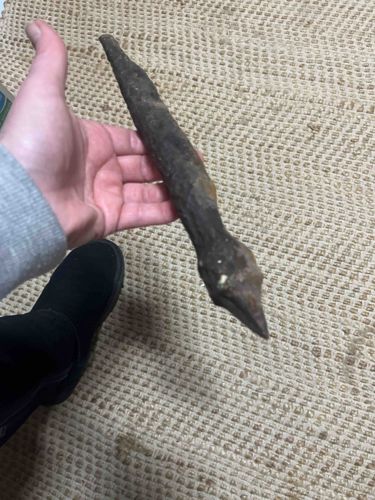
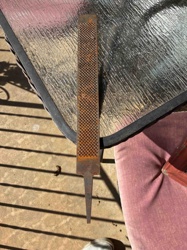
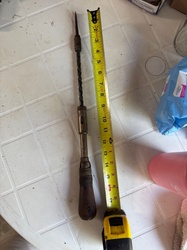
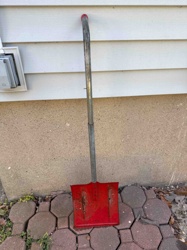
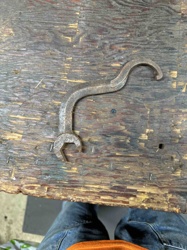
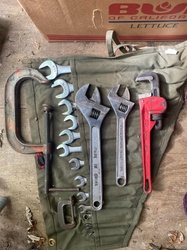
The item appears to be a vintage or antique hand tool, possibly a type of rebar bender or a similar construction-related leverage tool, likely made from heavy-duty steel or iron. It is dark gray to black in color, consistent with aged and possibly oxidized metal. The overall form is elongated and tapers to a chisel-like or pointed end. One end is significantly thicker and appears to be designed for gripping or impact, fitting comfortably within an average adult's hand as shown in the image, suggesting a length of approximately 10-15 inches. The other end, visible in the lower right, comes to a distinct, almost bird-beak-like point or wedge, implying it was used for prying, splitting, or shaping. The surface exhibits significant pitting, corrosion, and wear, characteristic of an item that has been exposed to the elements or heavily used over a long period. There are visible white specks, possibly residue from its environment or remnants of paint/coating, particularly near the pointed end. The construction seems robust and heavy, indicative of a tool built for demanding physical tasks. No discernible maker's marks or signatures are visible in the provided images, suggesting it might be an older, unmarked blacksmith-made piece, or simply that any markings are obscured by corrosion. The age is estimated to be mid-20th century or earlier, given the obvious signs of age and patina. The craftsmanship appears functional rather than ornate, typical of utilitarian tools.
AI Appraisal Report
Upon examining the provided image of this vintage/antique metal prying or bending tool, I assess its condition as fair to poor, displaying significant signs of age and heavy use, including extensive pitting, corrosion, and wear. The overall form suggests authenticity as a utilitarian hand tool from the mid-20th century or earlier, consistent with its apparent robust construction. Its design—a heavy-duty steel or iron piece tapering to a chisel-like or pointed end with a thick gripping end—aligns with tools used for tasks like rebar bending, prying, or splitting.
Market conditions for such unmarked, utilitarian vintage tools are generally modest. While there's a niche market among collectors of antique tools, blacksmith-made items, or industrial artifacts, the lack of discernible maker's marks significantly impacts its value. Comparables would include similar unmarked pry bars, crowbars, or specialized bending tools, which typically command prices ranging from $10 to $50 depending on unique features or historical significance. This item's primary value lies in its age and functional form rather than artistic merit or rarity; common tools like this are not particularly rare. Factors limiting its value are primarily the lack of provenance, the absence of any identifying marks, and its heavily corroded condition.
It is crucial to note the limitations of authenticity verification from images alone. Without physical examination, I cannot definitively confirm the metal composition, gauge the true extent of structural integrity obscured by corrosion, or search for faint, hidden maker's marks. An in-person inspection would allow for detailed tactile assessment, measurement, weight confirmation, and closer examination for obscured marks. Provenance documentation, such as records of prior ownership or historical usage, would significantly enhance its authentication and potential value, especially if linked to a specific trade or historical event. Scientific testing, like XRF analysis, could confirm metal composition and age more precisely.