AI Appraisal Estimate

AI-generated estimates · not official valuations

From the user

What was submitted

Photo and notes provided by the user — not generated by AI

Submitted item photo
Submitted photo · June 28, 2026

User's notes

No additional notes provided.

AI analysis below

AI appraisal

AI analysis & estimate

AI-Generated · Verify before acting

Everything below is generated by AI for informational purposes only. AI can make mistakes — the AI may misidentify items or misattribute them (artist, maker, brand, designer, origin, era). This is not an official valuation and should not be used for insurance, sale, tax, estate, legal, or lending purposes — or any decision requiring a certified appraisal. It is not an authoritative claim about any person, brand, or rights holder — do not share or rely on it as a factual statement about a third party. Always consult qualified professionals before making financial decisions.

Read the full disclaimer

AI Identification

·Not independently authenticated·Verify before acting

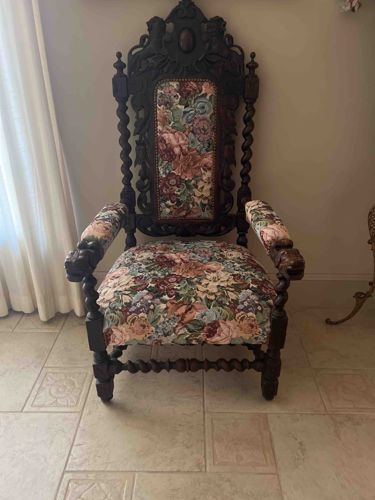
Carved Florentine Style Baroque Revival Armchair

Antique Furniture

AI Estimated Value

·Not an official valuation·Verify before acting

$1,800 - $2,600

As of June 28, 2026

AI Item Analysis

·AI can make mistakes·Verify before acting
This is a monumental throne-style armchair, likely a late 19th to early 20th-century European revival piece, potentially of Italian (Florentine) or French origin. The chair features an exceptionally high back adorned with intricate hand-carved openwork showcasing foliate scrolls, acanthus leaves, and a central oval medallion at the crest. The vertical supports are comprised of dramatic barley-twist (solomonic) columns terminating in finials. The armrests also feature these barley-twist supports and end in hand-carved lion mask terminals, a hallmark of Renaissance and Baroque revival furniture. The chair's frame is constructed from a dark-stained hardwood, possibly walnut or oak, displaying a rich, deep patina. It is upholstered in a floral tapestry-style fabric featuring roses and peonies in shades of dusty rose, sage green, and cream; however, this fabric appears to be a much later 20th-century replacement of the original textile. The upholstery is secured with brass-toned decorative nailhead trim. Structurally, the chair is supported by a barley-twist stretcher base. Condition-wise, the wood appears well-preserved with minor surface abrasions and dust accumulation in the deep carvings, consistent with age. No major fractures or missing carved elements are immediately visible. The craftsmanship is of high quality, indicating a skilled cabinetmaker or carver aimed at producing a prestige piece for a formal study or grand hall.
AI Appraisal Report

·AI can make mistakes·Verify before acting
I have conducted a visual examination of this monumental Florentine Style Baroque Revival armchair. Based on the intricate foliate openwork, Solomonic columns, and lion mask terminals, I identify this as a high-quality European revival piece dating to the late 19th century (circa 1880-1900). The wood, likely walnut given the crispness of the carvings, exhibits a deep, authentic patina consistent with age. Structurally, the barley-twist stretcher base appears robust, though the 20th-century floral upholstery is a clear replacement that, while functional, detracts slightly from the historical cohesion of the piece. The market for 'Brown Furniture' has stabilized for high-carat specialty items like this. Comparables at auction for similar Italian-origin throne chairs generally range from $1,500 to $3,000 depending on the level of detail. The rarity of the double-twist arm supports and the intact nature of the delicate crest carving place this in the upper tier of the revival market. The primary value driver is the craftsmanship of the hand-carved elements rather than the textile. Note: This appraisal is based on image analysis and carries inherent limitations. A physical inspection is required to confirm joinery techniques (looking for hand-plane marks or authentic hide glue) and to ensure there are no disguised repairs to the barley-twist legs. A definitive valuation would also benefit from provenance documentation linking it to a specific workshop. To fully authenticate, I would need to examine the underside of the frame for maker's marks and verify the wood species through microscopic fiber analysis if the origin remains contested.

Get your items appraised

Instant estimates of your treasures with AI-powered appraisals

Browse More Appraisals