These notes were written by the person who submitted this item. Appraiser.AI has not verified them, and the AI's identification and estimate may rely on them.
AI Estimated Value
Not an official valuation
$15-25
AI estimate as of July 9, 2025 · verify with a professional before acting
AI-Generated · Verify before acting
Everything on this page is generated by AI for informational purposes only. AI can make mistakes — the AI may misidentify items or misattribute them (artist, maker, brand, designer, origin, era). This is not an official valuation and should not be used for insurance, sale, tax, estate, legal, or lending purposes — or any decision requiring a certified appraisal. It is not an authoritative claim about any person, brand, or rights holder — do not share or rely on it as a factual statement about a third party. Always consult qualified professionals before making financial decisions.
This analysis also relies on unverified notes provided by the user, which may be incomplete or inaccurate and could affect the result.
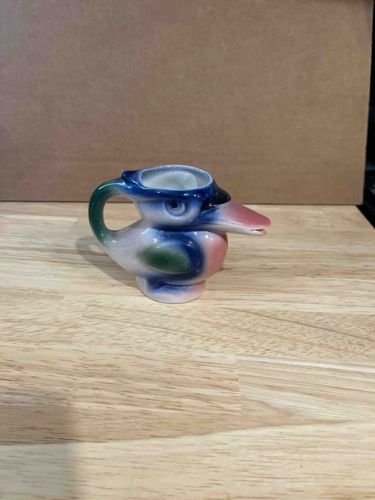
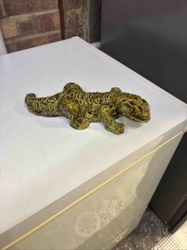
This item is a whimsical ceramic mini creamer, designed in the stylized form of a duck or bird, characteristic of mid-century novelty items. It is crafted from glazed ceramic, likely earthenware or porcelain, given its smooth, shiny finish. The primary colors are a soft, slightly off-white serving as the base, complemented by vibrant hand-painted details. The duck's head features a rich blue on the crown and around the eyes, with defined white eyeballs and black pupils. Its beak is a distinctive pale pink, tapering to a pointed spout for pouring. The handle, formed by the bird's tail or a wing, is a contrasting dark green. A patch of dark blue is visible on the chest or underbelly, along with a rounded green patch on its side, suggesting plumage. Another hint of pink appears on its lower body, completing the multi-colored 'feathered' appearance. The construction appears solid and well-molded, although it's difficult to assess thickness without direct handling. The glaze shows a consistent sheen across the piece, indicating good firing. There are no immediately apparent cracks, chips, or significant wear marks visible in the provided image, suggesting it is in good, possibly excellent, vintage condition for its age. The underside, which would typically contain manufacturing details or maker's marks, is not visible. Its small size, as implied by 'mini creamer', points to its use for individual servings of cream, milk, or perhaps as a decorative trinket. This piece exhibits strong craftsmanship for a mass-produced or semi-mass-produced item of its era, with neat application of glazes and colors.
AI Appraisal Report
Upon examining the provided images of this Mid-Century Ceramic Duck Mini Creamer, I assess it to be in very good to excellent vintage condition. The glaze appears intact, and the hand-painted details are vibrant and well-preserved, with no visible chips, cracks, or crazing. The whimsical, stylized design is characteristic of mass-produced novelty tableware from the 1950s and 1960s, often made in Japan or the USA. Authenticity for this type of item usually rests on its period style rather than a specific famous maker. The market for such mid-century ceramic collectibles is active but generally modest unless attributed to a highly sought-after designer or pottery like Shawnee or Lefton. The primary value driver here is its charming aesthetic and excellent condition. Demand is steady from collectors of mid-century kitsch and novelty creamers. Its rarity is low to moderate, as similar items were produced in large quantities. The lack of a visible maker's mark is a significant limiting factor; a mark from a known manufacturer could increase its value considerably. It is crucial to note that this appraisal is based solely on images. A full authentication would require in-person examination to check for a maker's mark on the underside, assess the piece for any hidden damage or repairs, and confirm the material and age of the ceramic.