Nodule of Black Flint or Chert
Geological Specimens / Minerals

Nodule of Black Flint or Chert

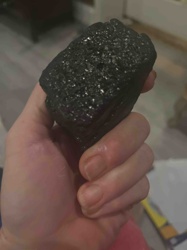
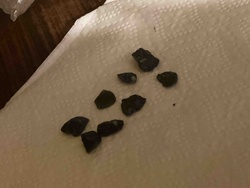
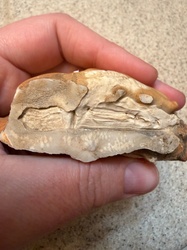
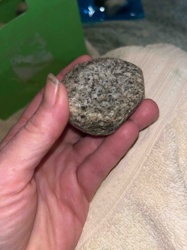
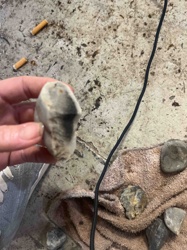
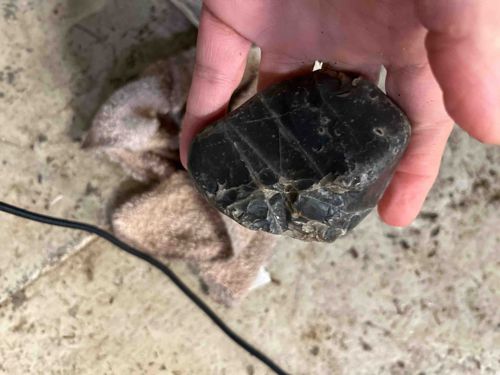
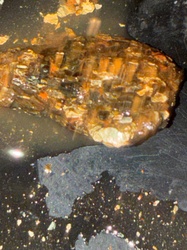
This specimen is a natural geological nodule, likely composed of black flint or chert, a microcrystalline variety of the mineral quartz. The item is approximately 3 to 4 inches in length, sized to fit within the palm of a human hand. Physically, it exhibits a dark, charcoal-to-black coloration with a matte to waxy surface luster. The stone displays characteristic conchoidal fracturing along its lower edge, where sharp, shell-like curves indicate where the material has been chipped or broken. Several prominent linear veins or internal fractures crisscross the surface, appearing as lighter grey or tan streaks. One side of the nodule appears naturally weathered and smoothed, possibly from alluvial or glacial movement, while the opposite side shows more recent mechanical damage or 'spalling.' There are no man-made markings, signatures, or evidence of intentional knapping (shaping into a tool), suggesting this is a raw mineral specimen rather than an artifact. The condition is raw and unpolished, showing typical 'chatter marks' and surface abrasions consistent with a found stone. Similar materials were historically prized in Stone Age tool-making for their ability to hold a razor-sharp edge.
Estimated Value

$15.00-$25.00

Basic Information

Category

Geological Specimens / Minerals

Appraised On

April 7, 2026

Estimated Value

$15.00-$25.00

Item Description

This specimen is a natural geological nodule, likely composed of black flint or chert, a microcrystalline variety of the mineral quartz. The item is approximately 3 to 4 inches in length, sized to fit within the palm of a human hand. Physically, it exhibits a dark, charcoal-to-black coloration with a matte to waxy surface luster. The stone displays characteristic conchoidal fracturing along its lower edge, where sharp, shell-like curves indicate where the material has been chipped or broken. Several prominent linear veins or internal fractures crisscross the surface, appearing as lighter grey or tan streaks. One side of the nodule appears naturally weathered and smoothed, possibly from alluvial or glacial movement, while the opposite side shows more recent mechanical damage or 'spalling.' There are no man-made markings, signatures, or evidence of intentional knapping (shaping into a tool), suggesting this is a raw mineral specimen rather than an artifact. The condition is raw and unpolished, showing typical 'chatter marks' and surface abrasions consistent with a found stone. Similar materials were historically prized in Stone Age tool-making for their ability to hold a razor-sharp edge.
Get Your Items Appraised

Instant estimates of your treasures with AI-powered instant appraisals

Browse More Appraisals