Given the limited information from the image, and assuming a standard commercially available piece with a bright, though unverified, colorless stone and a silver-colored metal, a preliminary estimate without physical inspection would range from $150 to $500. This range accounts for the possibility of the stone being a simulant or lower-grade natural stone and the metal being sterling silver or a lower-karat gold alloy. A definitive appraisal requires physical examination.
AI estimate as of June 17, 2025 · verify with a professional before acting
AI-Generated · Verify before acting
Everything on this page is generated by AI for informational purposes only. AI can make mistakes — the AI may misidentify items or misattribute them (artist, maker, brand, designer, origin, era). This is not an official valuation and should not be used for insurance, sale, tax, estate, legal, or lending purposes — or any decision requiring a certified appraisal. It is not an authoritative claim about any person, brand, or rights holder — do not share or rely on it as a factual statement about a third party. Always consult qualified professionals before making financial decisions.
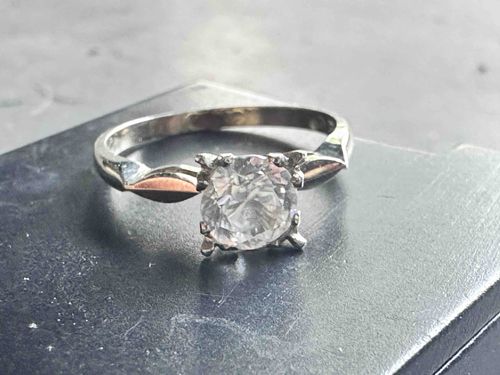
This item is a ladies' ring, likely a solitaire engagement or promise ring. The physical characteristics include a silver-colored band, probably made of white gold, platinum, or sterling silver, with a bright, colorless stone set at the crown. The band has a polished finish and appears to be relatively simple in design, with some subtle shaping near the setting. The stone is prominently featured and is held securely in a four-prong setting. The prongs are well-formed and evenly spaced. The stone itself is round and faceted, exhibiting significant brilliance and reflecting light effectively. The facets appear to be well-cut, contributing to the stone's sparkle. There are no visible markings or stamps in the image to indicate the metal purity or manufacturer, so further inspection would be required for those details. There appears to be some minor surface wear and possibly light scratches on the band consistent with normal use, but no major damage or repairs are immediately apparent. The setting seems to be in good condition, securely holding the stone. The stone's clarity and cut are indicators of its quality, though an in-person examination would be necessary to determine the exact type and value. Based on its design, it appears to be a modern piece, likely from the late 20th or early 21st century. The craftsmanship appears to be standard for mass-produced or commercially available jewelry of this style.
AI Appraisal Report
Based on my visual examination of the provided image of this ladies' solitaire ring, I can offer a preliminary assessment. The ring features a silver-colored band, likely white gold, platinum, or sterling silver, with a bright, colorless stone in a four-prong setting. The band shows some minor surface wear consistent with use but no significant damage. The stone appears round, faceted, and exhibits good brilliance, suggesting a well-cut stone. However, authenticity verification is limited from an image alone. I cannot definitively determine the metal type, gemstone type (diamond, moissanite, or simulant), clarity, color, or carat weight without physical examination and testing. Market conditions for solitaire rings are generally strong, with demand varying based on metal and stone type. Comparables would range significantly depending on whether the stone is a genuine diamond or a simulant, and the metal's purity. The simplicity of the design suggests it is not particularly rare. Factors significantly impacting value include the stone's material, its 4Cs (carat weight, cut, color, and clarity), and the metal's purity. To provide a definitive appraisal and verify authenticity, an in-person examination is crucial. This would allow for detailed observation for hallmarks, scientific testing (such as diamond testing, specific gravity, and metal purity testing), and precise measurement of the stone and ring. Provenance documentation, if available, could also shed light on its history and authenticity.