AI estimate as of July 12, 2025 · verify with a professional before acting
AI-Generated · Verify before acting
Everything on this page is generated by AI for informational purposes only. AI can make mistakes — the AI may misidentify items or misattribute them (artist, maker, brand, designer, origin, era). This is not an official valuation and should not be used for insurance, sale, tax, estate, legal, or lending purposes — or any decision requiring a certified appraisal. It is not an authoritative claim about any person, brand, or rights holder — do not share or rely on it as a factual statement about a third party. Always consult qualified professionals before making financial decisions.
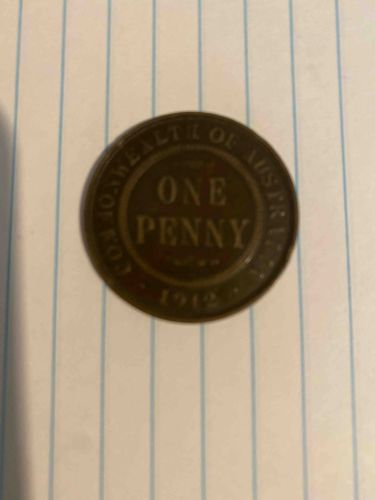
The item is a circular metal coin, appearing to be made of a copper or bronze alloy, consistent with the typical composition of historical pennies. Its color is a rich, dark brown with visible areas of lighter patination and some greenish discoloration, suggesting natural aging and exposure to elements over time. The obverse side (as mostly seen in the image) features a central inscription of "ONE PENNY" in capitalized block letters, enclosed within a circular border. Surrounding this inner circle, along the outer rim of the coin, are the words "COMMONWEALTH OF AUSTRALIA" at the top, and the date "1912" clearly visible at the bottom. The lettering on the coin shows wear consistent with circulation, with some characters less sharp than others, particularly on the outer text. There are no obvious signs of major damage like deep scratches or bends, but the surface exhibits a general softness of detail, indicating moderate to heavy wear. The overall craftsmanship appears to be standard for sovereign coinage of the early 20th century, with clear, legible inscriptions despite the wear. No distinct maker's marks or mint marks are discernible from the provided image. The coin's estimated age is precisely 1912 based on the inscribed date, placing it within the early 20th-century period of Australian coinage.
AI Appraisal Report
I have examined the provided image of what appears to be an Australian 1912 One Penny Coin. Based on visual cues, the coin exhibits characteristics consistent with an authentic Commonwealth of Australia penny from that era. The 'ONE PENNY' inscription, 'COMMONWEALTH OF AUSTRALIA' text, and the date '1912' are all present and align with known genuine examples. The general wear, evidenced by softened details and some character blurring, suggests a circulated condition, likely Fine (F) to Very Fine (VF) based solely on this image. The visible patination and greenish discoloration are typical of copper/bronze alloys aging naturally, further supporting authenticity rather than suggesting a modern counterfeit.
Market conditions for early Australian Commonwealth pennies are generally stable. The 1912 One Penny is not considered a rare date, with a relatively high mintage. Demand is moderate, primarily from collectors of Australian coinage. Its value is largely contingent on its condition. For a circulated 1912 Penny in this apparent condition, comparables typically range from a few dollars to perhaps twenty dollars.
Factors significantly impacting value include its circulated state, which reduces its monetary worth compared to uncirculated examples. While no significant damage is evident, the overall wear limits its appeal to high-grade collectors. No clear mint mark is visible, which would be crucial for precise identification and potentially higher value if it were, for example, a particularly rare mint variety.
It is crucial to note the limitations of appraising from an image alone. Authenticity cannot be 100% verified without physical inspection. A full in-person examination would allow me to assess the coin's true weight, diameter, edge characteristics, and tactile surface details, all of which are vital for definitive authentication. Microscopic analysis could reveal subtle details of the strike and wear patterns. Furthermore, provenance documentation would provide a historical chain of ownership, adding credibility. Scientific testing, such as XRF analysis, could confirm the metallic composition. Without these, my appraisal of authenticity is preliminary and based solely on the visual evidence provided.