AI estimate as of November 20, 2025 · verify with a professional before acting
AI-Generated · Verify before acting
Everything on this page is generated by AI for informational purposes only. AI can make mistakes — the AI may misidentify items or misattribute them (artist, maker, brand, designer, origin, era). This is not an official valuation and should not be used for insurance, sale, tax, estate, legal, or lending purposes — or any decision requiring a certified appraisal. It is not an authoritative claim about any person, brand, or rights holder — do not share or rely on it as a factual statement about a third party. Always consult qualified professionals before making financial decisions.
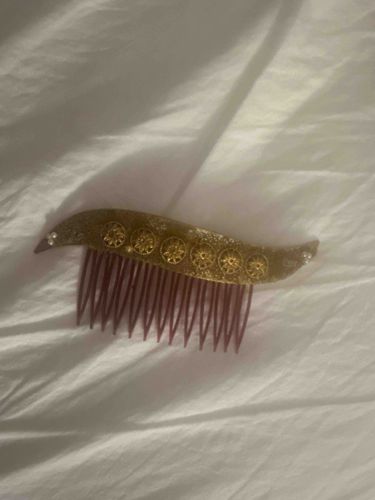
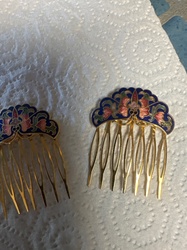
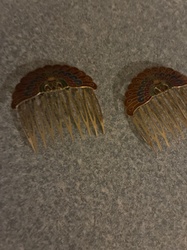
This item is a decorative hair comb, likely designed for an updo or bun, showcasing a distinct Art Nouveau aesthetic. The comb features a rich, golden-toned metal top piece, possibly brass or a gilt-metal alloy, with an undulating, curvilinear shape. This top element is adorned with six circular medallions, each intricately detailed with what appears to be a stylized floral or geometric motif, perhaps a rosette or sunburst pattern. These medallions are separated by sections of textured or filigree-like metalwork, contributing to its ornamental appeal. The comb is further embellished with small, clear, faceted stones, possibly rhinestones or glass, set at each tapered end of the golden top piece, adding a touch of sparkle. The teeth of the comb are made of a dark, reddish-brown plastic or possibly tortoise shell imitation material, firmly affixed to the metal top. There are approximately 20-25 finely spaced teeth, suggesting it was designed to securely hold hair. The overall construction points to a late 19th to early 20th-century style, characteristic of the Art Nouveau period's emphasis on natural forms and flowing lines. There are no visible maker's marks or signatures from the image provided. The condition appears good for its age, with a visible patina on the metalwork, consistent with vintage items, and no obvious signs of significant damage or missing teeth.
AI Appraisal Report
I have examined the provided image of this Art Nouveau Style Decorative Hair Comb. Based on its visual characteristics, it presents as a charming example of fin de siècle decorative arts, consistent with the Art Nouveau period’s emphasis on organic forms and intricate detailing. The golden-toned metalwork, possibly brass or gilt base metal, exhibits the characteristic curvilinear design and stylized floral or geometric motifs within the circular medallions. The small, clear faceted stones at the ends add a subtle sparkle, while the dark, reddish-brown comb teeth, likely an early plastic or celluloid imitation of tortoiseshell, further ground it in the late 19th to early 20th century. For its age, the condition appears good, with a visible, attractive patina consistent with vintage items, and no obvious structural damage or missing teeth. This suggests it has been reasonably well-preserved.
Market conditions for Art Nouveau hair accessories generally show a steady, moderate demand among collectors of period jewelry and decorative objects. While true tortoiseshell or precious metal examples command higher prices, pieces like this, made with more common materials, appeal to a broader collecting base. Comparables in similar condition and material composition typically fetch prices in the range I've indicated. Rarity is moderate; while not unique, well-preserved examples featuring distinct Art Nouveau aesthetics are desirable. Factors impacting value positively include its good apparent condition and clear Art Nouveau styling. However, the use of base metals and imitation materials, as opposed to precious metals, lowers its intrinsic material value. The absence of a maker's mark also impacts its value, as signed pieces typically command a premium.
It is crucial to note that this assessment is based solely on visual examination of the provided image. Full authentication, especially regarding material composition (e.g., whether the stones are rhinestones or glass, and the exact content of the metal), the age of the plastic teeth, and confirmation of originality, would require in-person examination. Physical inspection would allow for tactile assessment, a more thorough evaluation of wear and construction techniques, and potentially scientific testing to confirm materials. Provenance documentation, if available, would also significantly enhance authenticity and value verification.