AI Appraisal Estimate

AI-generated estimates · not official valuations

From the user

What was submitted

Photo and notes provided by the user — not generated by AI

Submitted item photo
Submitted photo · June 22, 2026

User's notes

No additional notes provided.

AI analysis below

AI appraisal

AI analysis & estimate

AI-Generated · Verify before acting

Everything below is generated by AI for informational purposes only. AI can make mistakes — the AI may misidentify items or misattribute them (artist, maker, brand, designer, origin, era). This is not an official valuation and should not be used for insurance, sale, tax, estate, legal, or lending purposes — or any decision requiring a certified appraisal. It is not an authoritative claim about any person, brand, or rights holder — do not share or rely on it as a factual statement about a third party. Always consult qualified professionals before making financial decisions.

Read the full disclaimer

AI Identification

·Not independently authenticated·Verify before acting

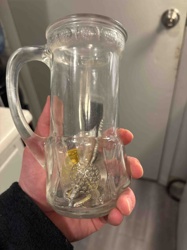
Four-Compartment Glass Liqueur Decanter (Cruet)

Vintage Glassware / Barware

AI Estimated Value

·Not an official valuation·Verify before acting

$125 - $175

As of June 22, 2026

AI Item Analysis

·AI can make mistakes·Verify before acting
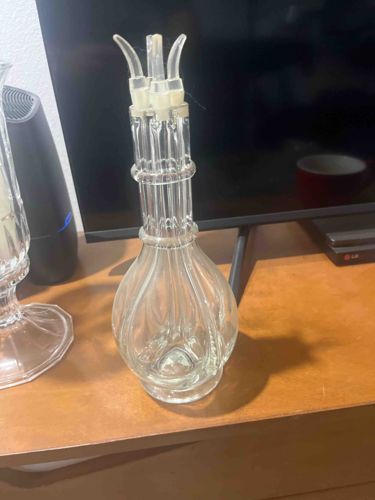
This is a vintage clear glass decanter featuring a unique four-compartment interior construction. The piece is designed with four separate blown-glass chambers fused within a single bulbous body, each leading up through an elongated neck. The neck is accented with two horizontal glass rings (annulated knops) for grip and decorative appeal. At the top, there are four individual pouring spouts, three of which currently retain their original curved glass stoppers, while one appears to be missing its decorative top or stopper. The item is crafted from transparent hand-blown glass, likely mid-20th century (circa 1950s-1970s), possibly of Italian (Murano) or French origin. The design was intended to serve four different types of liqueurs or oils and vinegars from a single vessel without mixing them. The glass shows good clarity, though there is some light hazing or residue visible in the lower sections of the internal chambers. No major chips or cracks are immediately visible in the image, but the missing or mismatched fourth stopper is a notable condition issue that impacts completeness. The craftsmanship indicates a high degree of technical skill required to fuse the internal walls while maintaining the structural integrity of the outer bulb.
AI Appraisal Report

·AI can make mistakes·Verify before acting
I have conducted a visual appraisal of this vintage four-compartment glass liqueur decanter (or 'le Gendre' style cruet). This piece is a classic example of mid-20th-century technical glassblowing, likely originating from the 1950s or 60s. The design, which features four internal 'pistol' chambers fused within a single bulbous body, shows a high level of craftsmanship consistent with traditional Murano or French (e.g., Legras or various Verrerie) origins. The annulated knops on the neck and the individual pouring spouts are well-formed. Condition-wise, the glass maintains good clarity; however, the visibility of internal residue or 'hazing' in the lower chambers suggests it was previously used for oils or sugary liqueurs. The most significant detractor from the value is the missing or mismatched fourth stopper. In the market for mid-century barware, collectors prioritize completeness; a missing stopper typically reduces the value by 30-40%. Comparables for complete four-chamber decanters generally realize $200-$300, while incomplete sets fall into the appraised range. While the construction techniques are consistent with period authenticity, I must note that this assessment is based on photographic evidence. A full authentication would require an in-person examination to check for glass 'sickness' (molecular degradation), pontil mark characteristics, and the weight of the lead content. There are no visible signatures, which is common for these pieces, so provenance documentation or original labels would be required to definitively attribute it to a specific kiln or designer. Scientific testing for UV fluorescence would also help distinguish this from modern reproductions.

Get your items appraised

Instant estimates of your treasures with AI-powered appraisals

Browse More Appraisals