AI estimate as of October 9, 2025 · verify with a professional before acting
AI-Generated · Verify before acting
Everything on this page is generated by AI for informational purposes only. AI can make mistakes — the AI may misidentify items or misattribute them (artist, maker, brand, designer, origin, era). This is not an official valuation and should not be used for insurance, sale, tax, estate, legal, or lending purposes — or any decision requiring a certified appraisal. It is not an authoritative claim about any person, brand, or rights holder — do not share or rely on it as a factual statement about a third party. Always consult qualified professionals before making financial decisions.
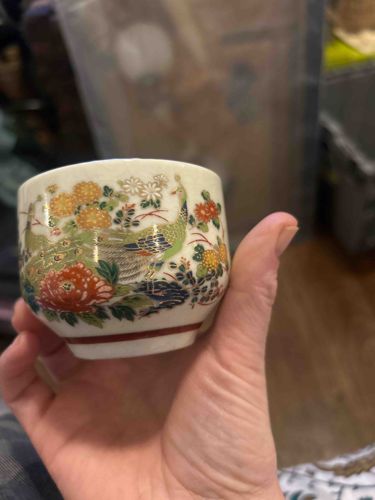
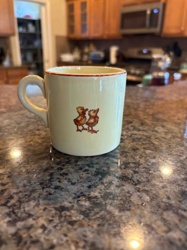
This exquisite small cup, likely a Japanese teacup or sake cup, is crafted from porcelain with a delicately crackled off-white glaze providing a refined textural background. The cup features intricate hand-painted polychrome decoration in an Imari or Kutani style, characterized by a rich palette of primary colors accented with gold. The central motif appears to be two peacocks or pheasants with detailed plumage in shades of green, gold, blue, and black, interspersed with a vibrant floral and foliage design. Prominent flowers include large reddish-orange peonies or chrysanthemums and smaller white and yellow chrysanthemums, alongside green leaves and delicate red accent lines. The gold detailing liberally applied to the birds' feathers and floral elements enhances the luxurious aesthetic. A distinctive dark red band encircles the lower portion of the cup, just above the foot rim, adding a contrasting detail. The cup is relatively small, designed to be held comfortably in the palm of a hand, indicating it is intended for sipping tea or sake. The porcelain exhibits a fine, almost translucent quality, suggesting good craftsmanship. The presence of fine crackling in the glaze (crazing) is visible and characteristic of certain types of Japanese ceramics, potentially indicating age or a specific firing technique. No obvious chips, cracks, or repairs are discernible from the available images, and the colors appear vibrant and well-preserved. Without a view of the base, specific maker's marks or signatures cannot be identified, which would typically help in pinpointing its exact origin and age. However, based on the decorative style, it likely dates from the late 19th to mid-20th century, a period when such ornate ceramic wares were popular, particularly for export.
AI Appraisal Report
Upon examining the provided image of this Japanese Imari-Style Porcelain Teacup/Sake Cup, I observe a well-preserved piece with vibrant polychrome decoration. The porcelain exhibits a fine, almost translucent quality, indicative of good craftsmanship. The hand-painted peacocks/pheasants, floral motifs, and extensive gold detailing are consistent with late 19th to mid-20th century Imari or Kutani styles, which were widely produced for both domestic and export markets. The visible fine crackling (crazing) in the glaze is a common characteristic and does not detract from its value; in some cases, it can enhance perceived antiquity. The colors appear strong and unfaded, and crucially, I see no obvious chips, cracks, or repairs from this visual assessment, suggesting excellent condition for its likely age.
Market conditions for such Japanese ceramic drinkware are generally stable but not soaring. While desirable for collectors of Imari and Kutani, cups without documented provenance or prestigious maker's marks typically fall into an accessible price range. Demand is steady for attractive, well-preserved examples, but rarity is not high given the production volume during its probable era. A significant factor impacting value is the lack of a visible maker's mark; without it, attributing it to a specific, highly collectible kiln is impossible, thus limiting its top-tier value.
It is imperative to state that this appraisal is based solely on visual inspection of the image. For full authentication and a definitive appraisal, an in-person examination would be critical. This would allow for inspection of the base for maker's marks or signatures, tactile assessment of the porcelain and glaze quality, and microscopic examination for any hidden repairs or restorations. Provenance documentation, if available, would also significantly enhance its value by confirming its history and origin.