AI estimate as of August 18, 2025 · verify with a professional before acting
AI-Generated · Verify before acting
Everything on this page is generated by AI for informational purposes only. AI can make mistakes — the AI may misidentify items or misattribute them (artist, maker, brand, designer, origin, era). This is not an official valuation and should not be used for insurance, sale, tax, estate, legal, or lending purposes — or any decision requiring a certified appraisal. It is not an authoritative claim about any person, brand, or rights holder — do not share or rely on it as a factual statement about a third party. Always consult qualified professionals before making financial decisions.
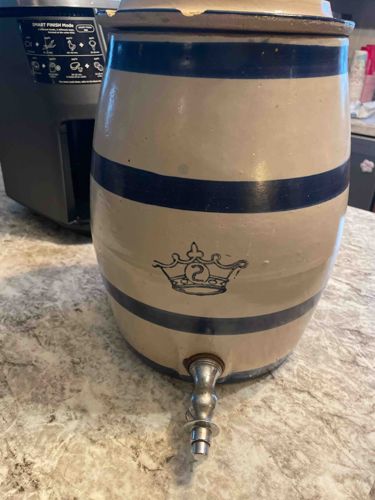
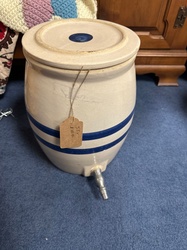
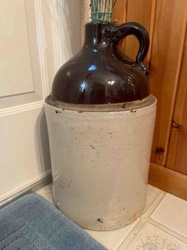
This is a vintage or antique stoneware crock, likely used for beverages such as water, as indicated by the presence of a metal spigot. The crock is barrel-shaped, with a wide body tapering slightly towards the top and bottom. It is constructed from a heavy, durable ceramic material, indicative of traditional stoneware, and features a muted, earthy beige or light grey base color. Two prominent horizontal bands of dark blue, approximately 1 to 1.5 inches wide, encircle the body. These bands are unevenly applied in some areas, suggesting hand-painting or a less mechanized production process. A distinctive graphic design, appearing to be a stylized crown with the number '2' inscribed within it, is centrally located on the front of the crock between the two blue bands. The crown motif and the number '2' likely denote the capacity in gallons, indicating this is a 2-gallon crock. The stoneware appears to be glazed, giving it a slightly glossy finish, but there are visible signs of wear and age, including minor discolored spots, scuffs, and possibly some surface pitting consistent with its utilitarian nature and age. The spigot, made of what appears to be brass or nickel-plated metal, shows some natural oxidation and patina, further supporting its vintage status. The lid, partially visible at the top, also appears to be made of the same stoneware material and fits snugly into the crock's opening. There are no clearly discernible maker's marks or signatures visible from the provided image, but the overall style, particularly the crown and number motif, is characteristic of American stoneware from the late 19th to early 20th century. The craftsmanship is robust and functional, showcasing the typical quality of utilitarian stoneware from that period. The visible condition suggests it has been used and is well-preserved for its age, though minor surface imperfections are present.
AI Appraisal Report
Upon examining the provided image of the Vintage 2-Gallon Stoneware Water Cooler with Crown and Number '2' Motif, I assess its condition as very good for its age, consistent with utilitarian stoneware from the late 19th to early 20th century. The visible surface imperfections, such as minor discolored spots, scuffs, and pitting, are typical signs of use and age, not significant damage. The metal spigot exhibits natural oxidation, reinforcing its vintage authenticity. The design, particularly the cobalt crown and '2' motif, is characteristic of American stoneware manufacturers like Red Wing Union Stoneware Co., which often used similar capacity markings. Authenticity, based on visual cues, appears strong for its period and origin. The two-gallon size is desirable for collectors, being large enough to be substantial but not excessively cumbersome. Demand for well-preserved American stoneware remains steady, especially for pieces with clear, attractive cobalt decorations and original components like the spigot and lid. The lack of a clear maker's mark within the image is a limitation; while the style points to specific manufacturers, definitive identification would require an in-person examination, potentially revealing subtle impressed marks or unique glaze characteristics. Provenance documentation, if available, would further enhance authentication and value. Without physical inspection, I cannot confirm the absence of hairline cracks, chips, or repairs hidden from view, which could significantly impact the valuation. Scientific testing is typically not applied to stoneware unless a specific material or dating question arises, which is not the case here.