From the user

What was submitted

Photo and notes provided by the user — not generated by AI

Submitted item photo
Submitted photo · May 15, 2026

User's notes

No additional notes provided.

AI analysis below

AI appraisal

AI analysis & estimate

AI-Generated · Verify before acting

Everything below is generated by AI for informational purposes only. AI can make mistakes — the AI may misidentify items or misattribute them (artist, maker, brand, designer, origin, era). This is not an official valuation and should not be used for insurance, sale, tax, estate, legal, or lending purposes — or any decision requiring a certified appraisal. It is not an authoritative claim about any person, brand, or rights holder — do not share or rely on it as a factual statement about a third party. Always consult qualified professionals before making financial decisions.

Read the full disclaimer

AI Identification

·Not independently authenticated·Verify before acting

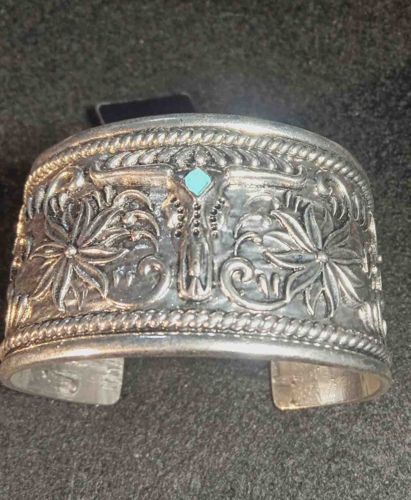
Southwestern-Style Longhorn and Floral Repouss Silver Cuff Bracelet

Jewelry

AI Estimated Value

·Not an official valuation·Verify before acting

$250.00 - $450.00

As of May 15, 2026

AI Item Analysis

·AI can make mistakes·Verify before acting
This is a wide, cuff-style bracelet crafted in a Western or Southwestern aesthetic. The piece is constructed from silver-toned metal, likely sterling silver or a silver-plated alloy, featuring a high-relief repouss and chased design. Centrally located on the cuff is a stylized longhorn steer skull, which is accented by a small, diamond-shaped turquoise cabochon set in the forehead. Flanking the central motif are intricate, symmetrical floral patterns resembling desert blooms or sunbursts, surrounded by scrolling foliate Victorian-style engravings. The top and bottom borders are finished with a distinct twisted rope or 'cable' edge, adding structural definition and texture. The interior of the cuff is smooth with a slight brushed finish, showing an open-back design for adjustable sizing. Condition-wise, the item exhibits an even, dark patina in the recessed areas, which serves to emphasize the sculptural detail, while the raised surfaces show minor surface scratches and evidence of gentle wear. There are no visible maker's marks or hallmarks in the provided view, though the craftsmanship suggests mid-to-late 20th-century artisan production. The turquoise displays a vibrant robin's egg blue hue with minimal matrix, securely bezel-set.
AI Appraisal Report

·AI can make mistakes·Verify before acting
I have virtually examined this Southwestern-style silver cuff bracelet. The piece demonstrates high-quality repoussé and chasing techniques, characteristic of mid-to-late 20th-century craftsmanship. The central longhorn motif and robin’s egg blue turquoise cabochon are well-executed, and the dark oxidation in the recesses creates a pleasing contrast that highlights the floral and foliate details. The condition appears to be 'Good to Very Good,' showing typical signs of wear and minor surface abrasions consistent with intermittent use. The market for Western-themed artisan jewelry remains steady, particularly for wide-cuff designs featuring 'bold' iconography. While the lack of a visible hallmark or 'Sterling' stamp suggests it may be a boutique artisan piece or a silver-plated alloy, the intricacy of the rope-edge border and central setting suggests a higher tier of production than mass-produced souvenirs. Comparables for unsigned Southwestern silver cuffs of this width typically fall in the $200–$500 range depending on metal purity. A significant limitation of this remote appraisal is the inability to verify metal content and stone authenticity. To finalize this valuation, I would require an in-person examination to conduct a density test or X-ray fluorescence (XRF) analysis to confirm if the base is .925 sterling silver or nickel silver. Additionally, physical inspection is required to determine if the turquoise is natural, stabilized, or synthetic, as natural untreated stones significantly command higher premiums. The absence of a maker’s mark restricts provenance; identifying the specific artisan through a signature would likely increase the rarity and value of the specimen.

Get your items appraised

Instant estimates of your treasures with AI-powered appraisals

Browse More Appraisals