AI estimate as of December 9, 2025 · verify with a professional before acting
AI-Generated · Verify before acting
Everything on this page is generated by AI for informational purposes only. AI can make mistakes — the AI may misidentify items or misattribute them (artist, maker, brand, designer, origin, era). This is not an official valuation and should not be used for insurance, sale, tax, estate, legal, or lending purposes — or any decision requiring a certified appraisal. It is not an authoritative claim about any person, brand, or rights holder — do not share or rely on it as a factual statement about a third party. Always consult qualified professionals before making financial decisions.
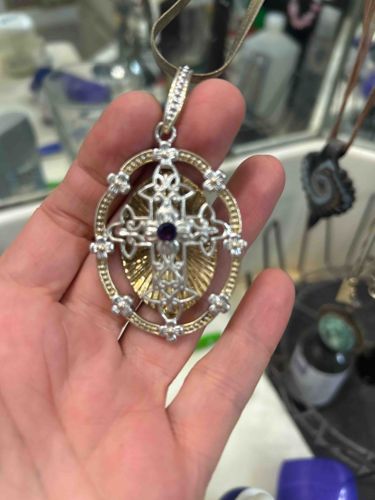
This is an elaborate two-tone medallion pendant, likely crafted from sterling silver and gold-plated or gold-filled metal, or possibly even solid gold and silver. The pendant features a prominent Celtic cross design at its center, rendered in silver-tone metal with intricate knotwork motifs. At the very center of the cross, a faceted, oval-cut purple stone, most likely an amethyst, is bezel-set, providing a focal point of color. This central cross is superimposed over a sunburst or radiating pattern in a warm, gold-tone metal, creating a striking contrast. An outer oval frame, also in two-tone metal, encircles the entire design. This frame is silver-tone and adorned with small, round, clear stones, presumably cubic zirconia or small diamonds, individually set at regular intervals around its circumference. The bail, where the pendant connects to its chain or cord, is also silver-toned and appears to be pavé-set with similar clear stones, adding to the piece's sparkle. The overall construction appears robust, suggesting good craftsmanship, although without closer inspection, details like solder joints and stone setting quality are hard to definitively assess. The pendant is currently suspended from a flat, light-colored fabric or leather cord, visible at the top of the image. There are no obvious signs of significant damage or repair, but some light surface wear consistent with age and use may be present, particularly on the metal finishes. The style suggests a contemporary take on classic Celtic and religious jewelry, possibly dating from the late 20th century to the present day. Its combination of precious or semi-precious metals and stones indicates a piece of some value and decorative appeal.
AI Appraisal Report
Based on my visual examination of the Two-Tone Celtic Cross Medallion Pendant, I assess its condition as good, showing no obvious signs of significant damage or repair. There may be some light surface wear on the metal finishes, consistent with normal use. The craftsmanship appears robust from the image. The authenticity of the materials, however, is difficult to definitively determine from photographs alone. The central purple stone is likely an amethyst, and the clear stones are most probably cubic zirconia, given their clarity and common use in similar designs. The metals appear to be a combination of sterling silver and a gold-plated or gold-filled base, rather than solid gold, which would significantly increase the value. Without physical inspection, detailed assessments of solder joints or diamond testing for the clear stones are impossible.
In terms of market conditions, there is a consistent demand for Celtic and religious-themed jewelry. Comparables in the market for two-tone pendants featuring semi-precious stones like amethyst and cubic zirconia, often crafted from sterling silver and gold-plating, typically range from $150 to $350. This piece is not particularly rare, as similar designs are widely produced. The primary factors impacting value are the actual metal content and the identity of the clear stones. If the gold-tone metal were solid gold or the clear stones were diamonds, the value would be substantially higher. For full authentication and a more precise appraisal, I would require an in-person examination to verify metal purity with a precious metal tester, stone identification with gemological tools, and a closer inspection of manufacturing quality and hallmarks.