AI estimate as of October 2, 2025 · verify with a professional before acting
AI-Generated · Verify before acting
Everything on this page is generated by AI for informational purposes only. AI can make mistakes — the AI may misidentify items or misattribute them (artist, maker, brand, designer, origin, era). This is not an official valuation and should not be used for insurance, sale, tax, estate, legal, or lending purposes — or any decision requiring a certified appraisal. It is not an authoritative claim about any person, brand, or rights holder — do not share or rely on it as a factual statement about a third party. Always consult qualified professionals before making financial decisions.
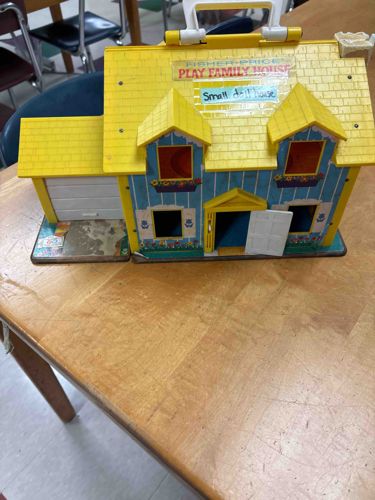
This item is a vintage Fisher-Price Play Family House, identifiable as one of their earlier A-frame styles, likely the No. 952 model due to its overall design and color scheme. The house is primarily constructed from brightly colored plastic, featuring a dominant yellow roof with molded shingle details and blue body with white vertical siding. The base appears to be made of a pressed wood or cardboard material with a lithographed graphic finish, mimicking a grassy yard and driveway. Notable features include a white, functioning garage door on the left side, a yellow-framed front door in the center (currently open with a white door panel swinging outward), and two distinct dormer windows on the front roof, each with red-orange frames and small flower box details. The house includes a white plastic carrying handle integrated into the top of the roof structure, suggesting its portability. 'FISHER-PRICE PLAY FAMILY HOUSE' is clearly printed on a label affixed to the front roof. Below this, a handwritten label, 'Small doll house', is taped onto the roof, indicating previous use. Condition-wise, the toy shows significant signs of playwear consistent with its age. There are visible scuffs, scratches, and missing lithograph details on the base near the garage entrance, exposing the brown material underneath. The plastic components exhibit some fading and general surface dirt. The garage door appears intact, and the front door, though open, seems to function. The white handle on top has some discoloration. The overall craftsmanship is typical of Fisher-Price toys from its era, focusing on durability and playability for young children. This particular model typically dates from the late 1960s to mid-1970s.
AI Appraisal Report
I have examined the provided image of this Fisher-Price Play Family House, an A-frame No. 952 style, dating from the late 1960s to mid-1970s. Its authenticity is visually confirmed by characteristic design elements, color scheme, and the 'FISHER-PRICE PLAY FAMILY HOUSE' label. The house appears complete, featuring the yellow roof, blue body, functioning garage, and front door. The white carrying handle is present, and the dormer windows add detail. However, its condition shows significant playwear. Visible scuffs, scratches, and missing lithograph on the base, particularly near the garage, are evident. The plastic components show signs of fading and general surface dirt, consistent with a well-played-with vintage toy. The handwritten 'Small doll house' label indicates previous ownership but does not affect value significantly.
Market conditions for this particular Fisher-Price model are steady among collectors of vintage toys, but this item's condition impacts its value. While these houses are sought after for nostalgia, examples in excellent or near-mint condition with original accessories command higher prices. This piece, having considerable wear, places it in the mid-to-lower range for its type. Demand is consistent, but rarity is moderate; these were popular toys, so many exist. Factors negatively impacting value are the lithograph loss, general wear, and color fading.
Authenticity verification from images alone is limited. A physical inspection would allow me to confirm the integrity of all moving parts (doors, handle), assess the extent of plastic brittleness or warping, and detect any potential repairs or touch-ups not visible in the photograph. I would also inspect all surfaces for deeper scratches, cracks, or staining. Additionally, verifying the exact model number from an imprinted mark rather than relying solely on visual cues would be ideal.