These notes were written by the person who submitted this item. Appraiser.AI has not verified them, and the AI's identification and estimate may rely on them.
AI Estimated Value
Not an official valuation
$3,000 - 5,000
AI estimate as of November 30, 2025 · verify with a professional before acting
AI-Generated · Verify before acting
Everything on this page is generated by AI for informational purposes only. AI can make mistakes — the AI may misidentify items or misattribute them (artist, maker, brand, designer, origin, era). This is not an official valuation and should not be used for insurance, sale, tax, estate, legal, or lending purposes — or any decision requiring a certified appraisal. It is not an authoritative claim about any person, brand, or rights holder — do not share or rely on it as a factual statement about a third party. Always consult qualified professionals before making financial decisions.
This analysis also relies on unverified notes provided by the user, which may be incomplete or inaccurate and could affect the result.
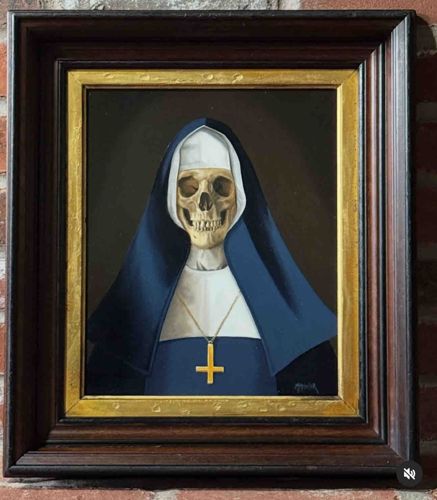
This item is an oil painting depicting a skeletal figure clad in a traditional nun's habit. The skull, rendered in naturalistic bone tones with visible teeth and eye sockets, sits prominently where a human face would typically be, suggesting a macabre or memento mori motif. The nun's habit consists of a white wimple and coif framing the skull, and a deep, rich navy blue veil and tunic. The draping of the fabric is detailed, showing realistic folds and shadows, indicating a skilled hand. A striking feature is the bright gold inverted cross pendant, suspended from a thin gold chain, resting centrally on the nun's chest against the dark blue tunic. The gold is rendered with highlights and shadows, giving it a metallic luster. The background of the portrait is a dark, indeterminate color, likely a deep brown or black, which serves to make the figure stand out. The painting is framed in a double frame: an inner gilded frame with a traditional profile, and an outer, wider frame made of dark wood, possibly walnut or mahogany, with a slightly textured or grained finish. The outer frame appears to have a subtle sheen, suggesting a polished surface, and shows minor wear consistent with handling and age, such as slight scuff marks. The overall aesthetic suggests a contemporary piece influenced by classical portraiture, but with a dark, gothic twist. The quality of the brushwork appears fine and controlled, signifying professional artistry. The use of strong contrasts between the skeletal figure, the dark habit, and the bright inverted cross creates a compelling and thought-provoking image.
AI Appraisal Report
I have visually examined the provided image of the "Nun Skeleton with Inverted Cross Pendant Painting." Based on the detailed description, this appears to be an original oil painting by Michele Melcher. The brushwork, evident in the detailed drapery and the realistic rendering of the skull and metallic pendant, signifies a professional level of artistry. The condition of the painting itself appears excellent from the image, with no visible damage or discoloration that would detract from its value. The double framing, particularly the outer dark wood frame with subtle wear, supports its presentation and suggests it has been cared for. The unique and thought-provoking subject matter, a blend of classical portraiture with a dark gothic twist, holds significant appeal for a niche market interested in memento mori, dark art, or contemporary figurative works. The contrast between the macabre subject and the symbolic inverted cross adds a layer of depth and intrigue, enhancing its demand among collectors attuned to such themes. As an original work by Michele Melcher, the artist's reputation and exhibition history would be crucial in determining the exact placement within the estimated range. Limited information on direct comparables for this specific artist’s work within this theme restricts a more precise valuation without further market data for Melcher's oeuvre. The item's originality contributes significantly to its rarity and value. For a complete authenticity verification and a more precise valuation, an in-person examination is critical to assess the paint's texture, canvas condition, and the frame's integrity, as well as to look for the artist's signature or other identifying marks not visible in the image. Provenance documentation, such as a certificate of authenticity or exhibition history, would also be invaluable.