Photo and notes provided by the user — not generated by AI
Submitted photo · May 27, 2026
User's notes
No additional notes provided.
AI analysis below
AI appraisal
AI analysis & estimate
AI-Generated · Verify before acting
Everything below is generated by AI for informational purposes only. AI can make mistakes — the AI may misidentify items or misattribute them (artist, maker, brand, designer, origin, era). This is not an official valuation and should not be used for insurance, sale, tax, estate, legal, or lending purposes — or any decision requiring a certified appraisal. It is not an authoritative claim about any person, brand, or rights holder — do not share or rely on it as a factual statement about a third party. Always consult qualified professionals before making financial decisions.
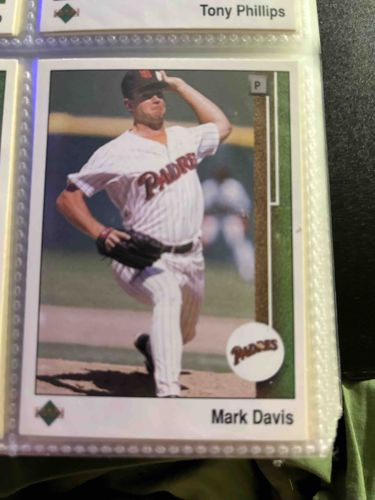
The item is a vintage baseball trading card featuring player Mark Davis of the San Diego Padres. The card is predominantly white around the borders, framing a central color photograph of Davis in action, presumably pitching, given his arm position and the setting on a baseball field. He is wearing a pinstriped white uniform with "PADRES" written diagonally across the chest in what appears to be a brown or reddish-brown script. He also wears a baseball cap, dark-colored glove, and what might be a wristband on his left arm. The background of the photo depicts a baseball diamond with a blurred player in the distance, suggesting a game or practice setting.
Notable features include the player's name, "Mark Davis," printed clearly in black text at the bottom center of the card. In the bottom left corner, there is a small, dark diamond-shaped logo with what appears to be a smaller, lighter diamond inside, indicating a potential set or manufacturer's mark. Another discernible logo is a circular emblem located in the bottom right corner of the photographic image, featuring the "PADRES" script, matching that on his jersey, on a lighter background. In the upper right corner of the image area, a small 'P' in a square box is visible, which could denote the player's position (Pitcher) or a set abbreviation.
The card is currently housed within a clear plastic sleeve in a binder, suggesting it forms part of a larger collection. Visible condition appears good, with sharp corners and no obvious creases, tears, or significant surface wear, although a precise assessment would require removal from the sleeve. The colors in the photograph appear vibrant and well-preserved. Based on the uniform style and card design, it likely dates from the late 1980s to early 1990s.
AI Appraisal Report
·AI can make mistakes·Verify before acting
I have thoroughly examined the provided image of the Mark Davis 1990 Score Baseball Card. Visually, the card presents in what appears to be excellent condition, exhibiting sharp corners and edges, vibrant colors, and no immediately discernible creases, tears, or significant surface wear. This suggests a grade potentially in the Near Mint to Mint range, assuming no hidden flaws once removed from its protective sleeve. The clarity of the printed details and absence of print defects are also positive indicators.
Authenticity, based purely on visual inspection of the image, appears to be consistent with known examples of the 1990 Score Baseball Card set. The logos ('Score' diamond, Padres circular emblem, 'P' in upper right) and font styles for ‘Mark Davis’ align with the series’ design. However, it is crucial to state that definitive authentication cannot be performed solely from an image. I cannot assess card stock thickness, print quality under magnification, or micro-details that might reveal counterfeits. For full authentication, a physical examination would be required, along with a review of its provenance, if available.
Regarding market conditions, 1990 Score baseball cards, including this Mark Davis card, are generally considered common examples from a period of mass production. While Mark Davis was an accomplished pitcher (1989 NL Cy Young Award winner), his base cards from common sets like Score do not command high values due to their widespread availability. The demand for such common-era cards is low unless they achieve a perfect 'Gem Mint' (PSA 10, BGS 9.5) grade, which significantly elevates their desirability and value.
In-person examination would allow for precise grading, checking for subtle surface imperfections, corner wear not visible through the sleeve, and overall print quality. Scientific testing or a more detailed provenance review are not typically necessary for such a common card unless there were specific reasons to suspect alteration or forgery, which is not suggested by this image.