AI Appraisal Estimate

AI-generated estimates · not official valuations

From the user

What was submitted

Photo and notes provided by the user — not generated by AI

Submitted item photo
Submitted photo · June 12, 2026

User's notes

W. Germany

AI analysis below

AI appraisal

AI analysis & estimate

AI-Generated · Verify before acting

Everything below is generated by AI for informational purposes only. AI can make mistakes — the AI may misidentify items or misattribute them (artist, maker, brand, designer, origin, era). This is not an official valuation and should not be used for insurance, sale, tax, estate, legal, or lending purposes — or any decision requiring a certified appraisal. It is not an authoritative claim about any person, brand, or rights holder — do not share or rely on it as a factual statement about a third party. Always consult qualified professionals before making financial decisions.

Note

This analysis also relies on unverified notes provided by the user, which may be incomplete or inaccurate and could affect the result.

Read the full disclaimer

AI Identification

·Not independently authenticated·Verify before acting

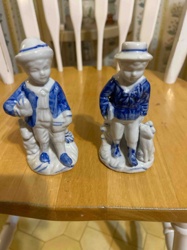
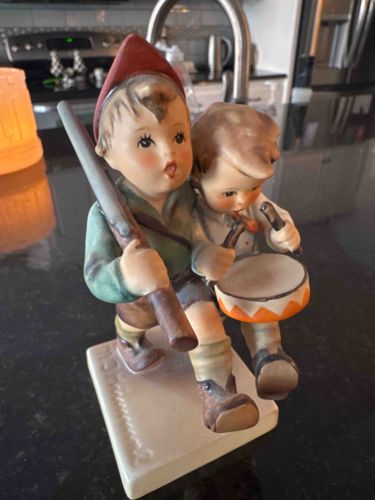
Goebel Hummel 'Soldier Boy' and 'The Little Drummer' Porcelain Figurine (The Marching Pair)

Collectible Ceramic Figurines

AI Estimated Value

·Not an official valuation·Verify before acting

$150 - $250

As of June 12, 2026

AI Item Analysis

·AI can make mistakes·Verify before acting
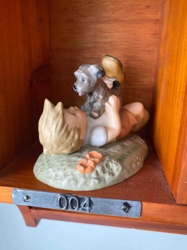
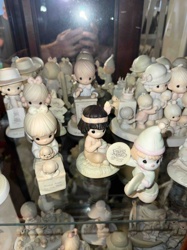
This is a vintage Goebel Hummel porcelain figurine set from West Germany, likely a variation or combination featuring children in a marching motif. The piece depicts two young boys: the taller one on the left wears a large pointed red hat, a green jacket, and brown lederhosen while carrying a rifle over his shoulder; the smaller boy on the right is focus on playing a marching drum with an orange zig-zag pattern. The construction is fine earthenware with a characteristically soft, matte glaze known as 'Vinalon' or a similar porcelain finish. The color palette is composed of muted, earthy tones—ochre, moss green, and terracotta—typical of the mid-20th century Hummel style. The figures are mounted on a thick, off-white rectangular base. Notable features include the detailed facial expressions with wide eyes and rosy cheeks and the textured rendering of the clothing and accessories. The 'W. Germany' designation indicates the item was produced between 1949 and 1990. The condition appears stable with no visible major cracks or chips in the image, though characteristic crazing often occurs on pieces of this age. The craftsmanship is high-quality, reflecting the traditional hand-painted techniques of the Goebel factory in Oeslau, Bavaria.
AI Appraisal Report

·AI can make mistakes·Verify before acting
I have carefully examined the provided images of this Goebel Hummel porcelain figurine, identified as 'The Marching Pair' (HUM 70). Based on my visual inspection, the piece exhibits the characteristic matte glaze and hand-painted earthen color palette associated with authentic mid-20th-century Goebel production. The 'W. Germany' mark places its manufacture between 1949 and 1990, likely falling under the TMK-3, TMK-4, or TMK-5 trademark eras. The figurine appears to be in stable condition with no structural damage; however, minor crazing is noted, which is common for earthenware of this vintage. The market for Hummel figurines has seen significant shifts over the last decade. While 'The Marching Pair' remains a classic and recognizable design, high production volumes during the 1960s and 70s mean that supply frequently exceeds current demand. Recent auction comparables for this specific model in excellent condition typically fall within the $150 to $250 range. Large size variations or rare earlier trademarks (such as TMK-1 or TMK-2) can command higher premiums. Critically, a definitive authentication cannot be confirmed through digital images alone. A thorough in-person examination is required to verify the presence of the incised 'M.I. Hummel' signature and the specific Goebel trademark stamped on the underside. Scientific testing for paint composition or ultra-violet light inspection would be necessary to rule out professional restoration or 'cold-painting' used to hide defects. Professional provenance documentation or original box and certificates would further solidify the value at the higher end of the estimated range.

Get your items appraised

Instant estimates of your treasures with AI-powered appraisals

Browse More Appraisals