AI estimate as of October 12, 2025 · verify with a professional before acting
AI-Generated · Verify before acting
Everything on this page is generated by AI for informational purposes only. AI can make mistakes — the AI may misidentify items or misattribute them (artist, maker, brand, designer, origin, era). This is not an official valuation and should not be used for insurance, sale, tax, estate, legal, or lending purposes — or any decision requiring a certified appraisal. It is not an authoritative claim about any person, brand, or rights holder — do not share or rely on it as a factual statement about a third party. Always consult qualified professionals before making financial decisions.
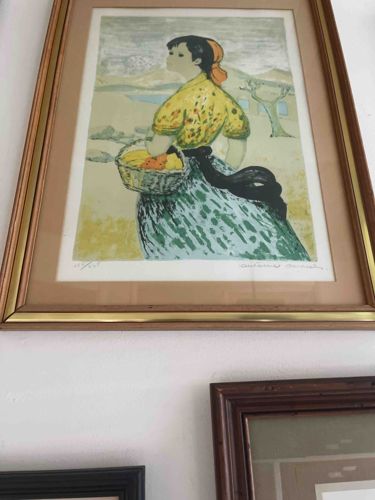
This item is a framed color lithograph depicting a young woman carrying a basket. The print is housed within a two-tone wooden frame, featuring a lighter, possibly natural, wood tone on the outer edge with a gold-toned metallic or lacquered inner bevel. The overall condition of the frame appears good, with minor signs of wear visible on the wood grain, consistent with age and handling. The print itself portrays a female figure in profile, facing right, with dark hair tied back with an orange or red scarf. She wears a yellow short-sleeved top with a subtle, possibly floral, pattern, and a flowing skirt in shades of blue and green with a dappled or abstract pattern, accented by a dark, possibly black, sash or belt. She carries a woven basket filled with what appears to be yellow and orange fruits. The background is a pastoral landscape, with muted greens and blues suggesting distant hills or water, and a solitary, sparse tree on the right. The color palette is relatively subdued yet vibrant in the subject's clothing. On the bottom left corner of the print, legible numbers '177/275' are inscribed, indicating a limited edition print, with this being the 177th out of 275 copies. Adjacent to this, in the bottom right, there appears to be a signature, though it is difficult to decipher definitively from the image, possibly reading 'Carole... something' or similar. The art style leans towards post-impressionistic or decorative, likely from the mid to late 20th century. The quality of the lithography appears fine, with good color registration. No overt damage like tears, significant fading, or water stains are visible on the print itself, though a full assessment would require closer inspection out of the frame.
AI Appraisal Report
Based on my visual examination of the provided image, this Framed Color Lithograph 'Young Woman with Basket' is in good overall condition. The print itself shows no visible tears, significant fading, or water stains, suggesting it has been well-preserved. The colors appear vibrant for its likely age. The two-tone wooden frame, while showing minor wear consistent with handling and age, complements the artwork effectively. The inscription '177/275' clearly indicates it is a limited edition print, which adds a degree of collectibility over an open edition. The art style, leaning towards post-impressionistic or decorative, is generally appealing. The content, a pastoral scene with a female figure, is also widely accessible.
Market conditions for mid-to-late 20th-century limited edition lithographs by unestablished or mid-tier artists can be variable. While the limited edition aspect, with 275 copies, creates a rarity component, the demand is largely driven by the artist's recognition and the aesthetic appeal of the piece. Without a clearly decipherable signature, attributing this work to a known artist is impossible. My appraisal range reflects the value for an attractive, limited edition print by an undocumented artist, considering its good condition and presentation.
Factors significantly impacting value include the potential for the signature to be identified as a recognized artist; such identification would substantially increase its value. Conversely, if the artist remains anonymous, the value hinges primarily on its decorative appeal. A full authentication would require an in-person examination to assess the print's paper quality, precise printing technique, and to definitively identify the artist's signature through comparison with known examples. Provenance documentation, including original purchase receipts or artist's certificates, would also aid in verifying authenticity and enhancing value. Without these, the authenticity of the signature and the print's origin cannot be fully confirmed from the image alone.