AI estimate as of August 9, 2025 · verify with a professional before acting
AI-Generated · Verify before acting
Everything on this page is generated by AI for informational purposes only. AI can make mistakes — the AI may misidentify items or misattribute them (artist, maker, brand, designer, origin, era). This is not an official valuation and should not be used for insurance, sale, tax, estate, legal, or lending purposes — or any decision requiring a certified appraisal. It is not an authoritative claim about any person, brand, or rights holder — do not share or rely on it as a factual statement about a third party. Always consult qualified professionals before making financial decisions.
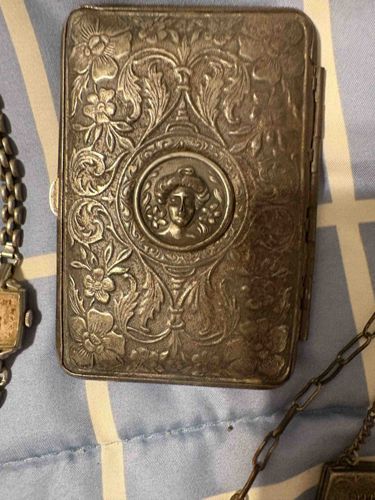
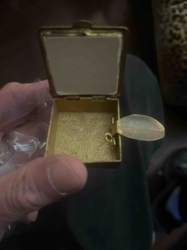
This item is a rectangular metallic case, likely a hinged box or compact, exhibiting elaborate repoussé or stamped decoration. Its dimensions appear to be small, suitable for holding personal effects. The material seems to be a silver-toned metal, possibly silver, silver-plate, or nickel silver, displaying a significant amount of dark patina, indicating age and lack of recent polishing. The overall color is a dull, oxidized silver-grey. The front surface is almost entirely covered with highly detailed, raised ornamentation. The central feature is an oval medallion containing a finely rendered portrait of a woman's head, possibly a classical or allegorical figure, distinguished by flowing hair and a serene expression, surrounded by a floral wreath border. This central motif is flanked by intricate scrollwork, acanthus leaves, and stylized floral patterns, including prominent blossoms that resemble dogwood or primroses. The craftsmanship suggests a high level of detail and precision in the mold or stamping process. Visible condition issues include significant tarnish and some surface wear, particularly on the raised elements where the metal might have been rubbed over time, revealing lighter areas beneath the patina. There are no immediately obvious dents or structural damage. The hinge mechanism is visible on the right side, appearing robust and integrated into the design. No maker's marks or signatures are discernable from this perspective. Based on the artistic style, particularly the neoclassical portraiture combined with naturalistic floral motifs and the general Victorian/Edwardian aesthetic of such personal items, this piece likely dates from the late 19th to early 20th century. The ornate decoration and metallic construction point to it being a well-made, potentially mass-produced but still high-quality item of its period.
AI Appraisal Report
Upon visual examination of this ornate metallic case, I assess its condition as good vintage, primarily noting significant, attractive patina and some surface wear consistent with age and handling. The intricate repoussé or stamped decoration, particularly the central female portrait medallion flanked by elaborate scrollwork and floral motifs, speaks to its authenticity as a late 19th to early 20th-century personal accessory. The artistic style, blending neoclassical elements with naturalistic floral patterns, aligns well with the Victorian/Edwardian aesthetic.
Authenticity, based solely on photographic evidence, appears strong. However, for full authentication, an in-person examination would be crucial to verify the metal composition (e.g., sterling silver vs. silver-plate), detect any restoration, and search for faint maker's marks or hallmarks not visible in the image. Provenance documentation, if available, would further enhance its historical context and value. Scientific testing, such as XRF analysis for metal composition, would provide definitive material identification.
In terms of market conditions, similar antique/vintage compacts, snuff boxes, or card cases with comparable detail and condition generally fetch varying prices. Demand for intricately decorated feminine accessories from this period remains steady among collectors of vanity items and historical ephemera. While not exceedingly rare, the quality of the relief work and the presumed good structural integrity contribute to its desirability. Factors significantly impacting value include the actual metal content (sterling would command a higher price), the presence of a known maker's mark, and rarity of the specific design. Without physical inspection, the potential for this being silver-plated rather than solid silver limits the top-end valuation.
Considering these factors, I estimate an appraisal value based on its aesthetic appeal, craftsmanship, and presumed good condition given the visual evidence.