These notes were written by the person who submitted this item. Appraiser.AI has not verified them, and the AI's identification and estimate may rely on them.
AI Estimated Value
Not an official valuation
$600-900
AI estimate as of July 22, 2025 · verify with a professional before acting
AI-Generated · Verify before acting
Everything on this page is generated by AI for informational purposes only. AI can make mistakes — the AI may misidentify items or misattribute them (artist, maker, brand, designer, origin, era). This is not an official valuation and should not be used for insurance, sale, tax, estate, legal, or lending purposes — or any decision requiring a certified appraisal. It is not an authoritative claim about any person, brand, or rights holder — do not share or rely on it as a factual statement about a third party. Always consult qualified professionals before making financial decisions.
This analysis also relies on unverified notes provided by the user, which may be incomplete or inaccurate and could affect the result.
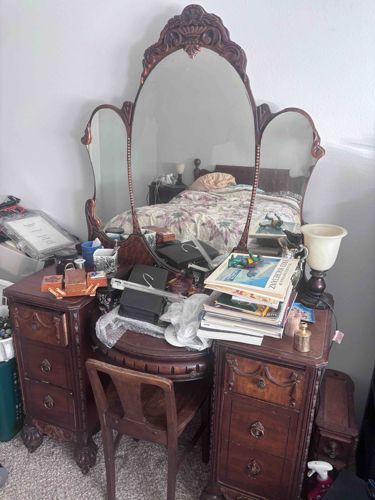
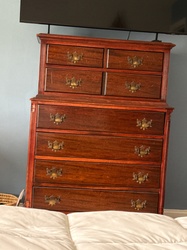
This item is an antique vanity dresser with a tripartite mirror system, dating approximately to the Art Deco period (1920s-1940s) or potentially the late Victorian/Edwardian era, given its ornamental carving. The piece is constructed from a dark-stained wood, likely mahogany or walnut, exhibiting a rich, deep reddish-brown hue. It comprises a central dressing table area with a semicircular, possibly hinged or retractable, surface, flanked by two symmetrical pedestals. Each pedestal features three drawers, providing ample storage. The drawer fronts are adorned with carved details, including a swag or garland motif near the top drawer and leaf-like or scrollwork elements on the lower drawers. The drawers are equipped with ornate metal pull handles, possibly brass or bronze, that appear to have a ring or bail design. The vanity stands on carved feet that resemble lion's paws or ornate scrollwork, indicating a high degree of craftsmanship.
The most striking feature is the mirror assembly. It consists of a large central oval mirror, topped with an elaborate carved pediment featuring rococo-inspired scrollwork and shell motifs. Flanking the central mirror are two smaller, elongated, articulated mirrors, each with similarly carved frames at their bases, allowing them to pivot for multiple viewing angles. The wood frame of the mirrors is intricately shaped with curves and decorative elements. The overall condition shows signs of age-appropriate wear, including minor scuffs, scratches, and a visible patina on the wood surface, which is consistent with its antique status. There are no obvious signs of major damage or recent repairs, though a detailed inspection would be needed to confirm this. The craftsmanship suggests a factory-made piece of good quality, typical of mass-produced furniture from the early to mid-20th century, designed to emulate more luxurious styles.
AI Appraisal Report
Based on my visual examination of the provided image, this Antique Art Deco/Victorian Style Vanity with Tripartite Mirror appears to be a factory-made piece from the early to mid-20th century. The dark-stained wood, ornate carvings, and elaborate tripartite mirror system are consistent with both late Victorian/Edwardian and early Art Deco design influences.
I assess the condition as good, considering its age. The description mentions minor scuffs, scratches, and patina, which are expected wear for an antique of this type. There are no obvious signs of major damage or recent repairs from the image, suggesting original integrity.
In terms of market conditions, vanities like this, while attractive, are not currently in extremely high demand compared to other antique furniture categories. However, the tripartite mirror and intricate carving add appeal. Comparables typically range, with simpler pieces being less, and more elaborate, well-preserved examples fetching higher prices. The 'factory-made' nature, while indicating good quality for its time, means it's not a unique artisan piece, impacting rarity.
Factors significantly impacting its value include its overall visual appeal, the multi-panel mirror system, the ornate carvings (swag, scrollwork, lion's paw feet), and the apparent good condition. However, the lack of a known maker or specific historical significance, common for mass-produced items, limits its top-tier value.
It is crucial to note that this authenticity verification has limitations. From images alone, I cannot definitively ascertain the wood type (mahogany vs. walnut) or the material of the metal pulls without a physical inspection. A full authentication would require an in-person examination to assess structural integrity, verify wood species, inspect joinery for construction methods, and examine hardware for authenticity. Provenance documentation, such as original purchase records or family history, would also add to its authenticated value.