AI estimate as of October 7, 2025 · verify with a professional before acting
AI-Generated · Verify before acting
Everything on this page is generated by AI for informational purposes only. AI can make mistakes — the AI may misidentify items or misattribute them (artist, maker, brand, designer, origin, era). This is not an official valuation and should not be used for insurance, sale, tax, estate, legal, or lending purposes — or any decision requiring a certified appraisal. It is not an authoritative claim about any person, brand, or rights holder — do not share or rely on it as a factual statement about a third party. Always consult qualified professionals before making financial decisions.
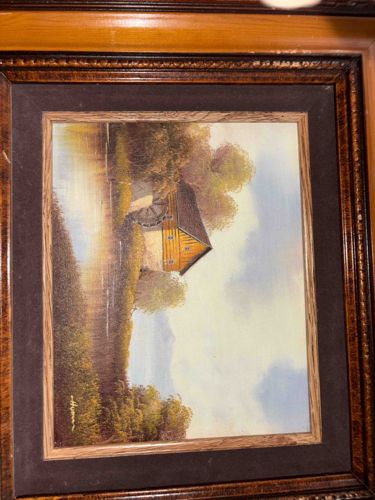
This item is a framed landscape painting, likely an oil or acrylic on canvas or board, depicting a rustic scene with a mill beside a body of water under a diffused sky. The painting is oriented vertically, showcasing a warm, inviting color palette dominated by earthy greens and browns for the foliage, a golden yellow for the mill, and soft blues and whites for the sky. The mill, a prominent feature, has a dark brown roof and appears to have a water wheel visible on its side. Lush greenery and trees line the banks of the water, which reflects a golden light, possibly from a setting or rising sun. The brushwork appears somewhat detailed, particularly in the rendering of the trees and the architectural elements of the mill. A signature, partially visible and seemingly in a cursive style, is present in the lower left corner of the painting. The artwork is housed within a two-tiered wooden frame. The inner frame, directly bordering the painting, is a light natural wood color, possibly oak, with a subtle grain visible. This is surrounded by a darker, textured brown mat or liner. The outermost frame is a richer, darker wood with a prominent grain and a glossy finish, featuring decorative carved or molded details, particularly along the inside edge. The frame shows some signs of wear consistent with age, such as minor scuffs or scratches, especially visible on the top edge, indicating a moderate age, likely mid to late 20th century. The overall condition of the painting itself appears good, with no obvious major damage like tears, punctures, or significant paint loss discernible from the image. The style suggests a traditional, perhaps slightly impressionistic, approach to landscape art, emphasizing a peaceful, natural setting.
AI Appraisal Report
Having visually examined the provided image of the 'Lakeside Mill Landscape Painting,' I assess its condition as good. The painting itself appears free from major damage such as tears or significant paint loss. The frame, while showing minor scuffs and scratches consistent with age, remains largely intact. The style suggests a traditional, possibly slightly impressionistic approach. The visible signature in the lower-left corner could be key to identification, but without clear legibility, it's difficult to attribute.
In terms of market conditions, paintings of this style and period (likely mid to late 20th century) are generally prevalent. Without a known or recognized artist, demand is typically moderate, driven more by decorative appeal than investment potential. Comparable unsigned or decoratively signed landscape paintings of this size and era often sell within a modest range at regional auctions or online marketplaces. Rarity is difficult to ascertain without artist identification, but similar examples are common.
The primary factor impacting value is the unknown artist; if the signature belongs to a listed or collectible artist, the value could significantly increase. However, based on the current information, it is largely valued as a decorative piece. For full authentication and to definitively verify the artist, an in-person examination would be crucial. This would allow for a detailed inspection of the brushwork, surface texture, and the signature itself. Additionally, provenance documentation (history of ownership) or scientific testing of materials (e.g., paint analysis) would be required to confirm authenticity beyond visual assessment.