AI estimate as of August 24, 2025 · verify with a professional before acting
AI-Generated · Verify before acting
Everything on this page is generated by AI for informational purposes only. AI can make mistakes — the AI may misidentify items or misattribute them (artist, maker, brand, designer, origin, era). This is not an official valuation and should not be used for insurance, sale, tax, estate, legal, or lending purposes — or any decision requiring a certified appraisal. It is not an authoritative claim about any person, brand, or rights holder — do not share or rely on it as a factual statement about a third party. Always consult qualified professionals before making financial decisions.
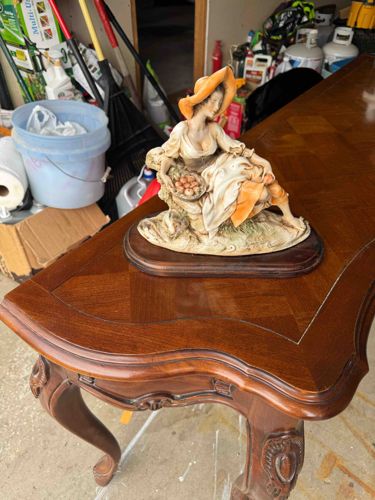
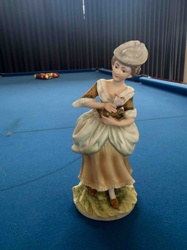
This appears to be a porcelain or ceramic figurine depicting a seated woman, possibly a fruit vendor or a representation of abundance. The woman is rendered in a classical or romantic style, with flowing drapery and a wide-brimmed hat. Her clothing is primarily in muted tones of cream and off-white, with noticeable accents of a warm, burnt orange color on her hat and parts of her dress. She holds or is seated next to a basket brimming with what appear to be peaches or similar round fruits. The base of the figurine is sculpted to resemble natural ground, with some green coloring suggestive of grass. The overall color palette is relatively subtle, indicating an attempt at a naturalistic or antique finish. The figurine is mounted on a separate, darker brown, possibly wooden or composite, elliptical base, enhancing its presentation. While specific dimensions are not provided, its placement on the table suggests it is a medium-sized decorative piece, likely in the range of 10-15 inches in height. There are no obvious visible chips, cracks, or significant damage on the figure itself, suggesting it is in good condition. The craftsmanship appears to be detailed, particularly in the rendering of the facial features, hands, and the texture of the clothing and fruit. The style suggests it could be Italian porcelain, possibly Capodimonte or a similar studio, known for romantic and pastoral themes, likely from the mid to late 20th century. There are no visible maker's marks or signatures in the provided images.
AI Appraisal Report
Upon visual examination of the provided image, this porcelain figurine depicting a seated woman with a fruit basket appears to be in very good condition, with no visible chips, cracks, or significant damage. The detailed craftsmanship, particularly in the facial features, hands, and the rendering of the drapery and fruit, suggests a piece of quality. The style, with its romantic and pastoral theme, and the characteristic muted tones with burnt orange accents, strongly points towards a potential Italian origin, possibly Capodimonte or a similar studio, likely dating to the mid to late 20th century.
Market conditions for such decorative porcelain pieces can vary. While demand for general decorative items remains steady, pieces with clear provenance or highly recognizable maker's marks typically command higher prices. This specific piece, lacking a visible maker's mark, makes definitive attribution challenging via images alone. If it were confirmed to be an authentic Capodimonte or a piece by a prominent Italian porcelain manufacturer, its value would significantly increase.
Factors impacting value include the excellent apparent condition and the detailed craftsmanship. However, the absence of a visible signature or mark, and the commonality of similar styles from various factories, limit its current market appeal as a high-end collectible. Rarity is difficult to assess without maker identification, but pieces of this genre were produced in considerable quantities.
It is crucial to note that authenticity verification is severely limited without a physical inspection. For full authentication and a more precise valuation, an in-person examination would be necessary to check for hidden marks, assess the true quality of the porcelain, and detect any restoration. Provenance documentation, such as original purchase receipts or certificates, would also be invaluable. Scientific testing is generally not required for this type of item unless there is suspicion of repair or material composition questions.