Small Irregular Lithic Fragment or Debitage
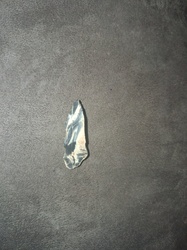
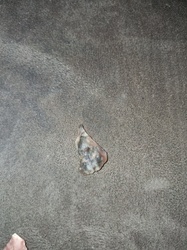
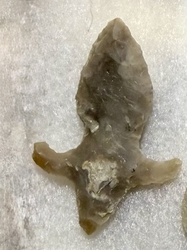
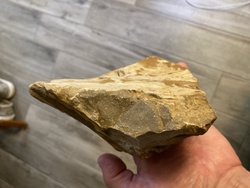
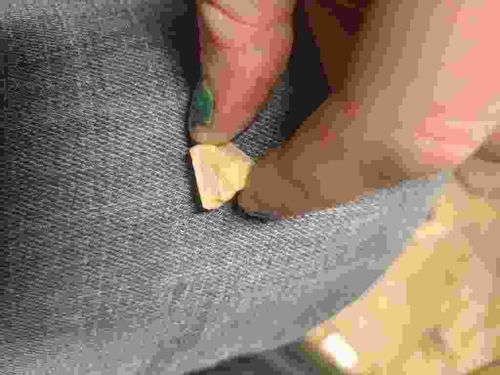
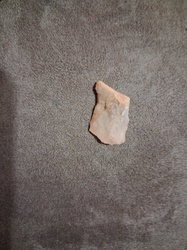
This item is a very small, irregular fragment of lithic material, likely chert or a similar fine-grained stone, being held between two fingers against a grey fabric backdrop. It measures approximately 1 to 1.5 cm in length. The fragment displays a pale yellowish-tan or cream color with a matte surface texture. Its shape is roughly triangular or trapezoidal with sharp, thin edges, suggesting it may be a piece of 'debitage' - the waste flake material produced during the manufacture of a stone tool. The cross-section appears thin, showing some evidence of a conchoidal fracture which is characteristic of flint-knapping. The condition is raw and unpolished, with no obvious signs of intentional secondary retouching or formal shaping into a specific tool type like an arrowhead or scraper. There are no visible maker's marks or signatures, which is standard for prehistoric or archaeological stone fragments. The piece appears to be in an unmodified state since its original fracture, showing little signs of modern wear, though its age is difficult to determine without archaeological context; it could range from modern 'knap-in' waste to a prehistoric artifact. The craftsmanship is non-existent as it appears to be a byproduct rather than a finished object.
AI-Generated Appraisal Disclaimer
Estimated Value
$1.00 - $5.00
Basic Information
Category
Lithic Artifacts / Archaeological Material
Appraised On
March 29, 2026
Estimated Value
$1.00 - $5.00
Item Description
This item is a very small, irregular fragment of lithic material, likely chert or a similar fine-grained stone, being held between two fingers against a grey fabric backdrop. It measures approximately 1 to 1.5 cm in length. The fragment displays a pale yellowish-tan or cream color with a matte surface texture. Its shape is roughly triangular or trapezoidal with sharp, thin edges, suggesting it may be a piece of 'debitage' - the waste flake material produced during the manufacture of a stone tool. The cross-section appears thin, showing some evidence of a conchoidal fracture which is characteristic of flint-knapping. The condition is raw and unpolished, with no obvious signs of intentional secondary retouching or formal shaping into a specific tool type like an arrowhead or scraper. There are no visible maker's marks or signatures, which is standard for prehistoric or archaeological stone fragments. The piece appears to be in an unmodified state since its original fracture, showing little signs of modern wear, though its age is difficult to determine without archaeological context; it could range from modern 'knap-in' waste to a prehistoric artifact. The craftsmanship is non-existent as it appears to be a byproduct rather than a finished object.
Get Your Items Appraised
Instant estimates of your treasures with AI-powered instant appraisals