AI Appraisal Estimate

AI-generated estimates · not official valuations

From the user

What was submitted

Photo and notes provided by the user — not generated by AI

Submitted item photo
Submitted photo · May 28, 2026

User's notes

No additional notes provided.

AI analysis below

AI appraisal

AI analysis & estimate

AI-Generated · Verify before acting

Everything below is generated by AI for informational purposes only. AI can make mistakes — the AI may misidentify items or misattribute them (artist, maker, brand, designer, origin, era). This is not an official valuation and should not be used for insurance, sale, tax, estate, legal, or lending purposes — or any decision requiring a certified appraisal. It is not an authoritative claim about any person, brand, or rights holder — do not share or rely on it as a factual statement about a third party. Always consult qualified professionals before making financial decisions.

Read the full disclaimer

AI Identification

·Not independently authenticated·Verify before acting

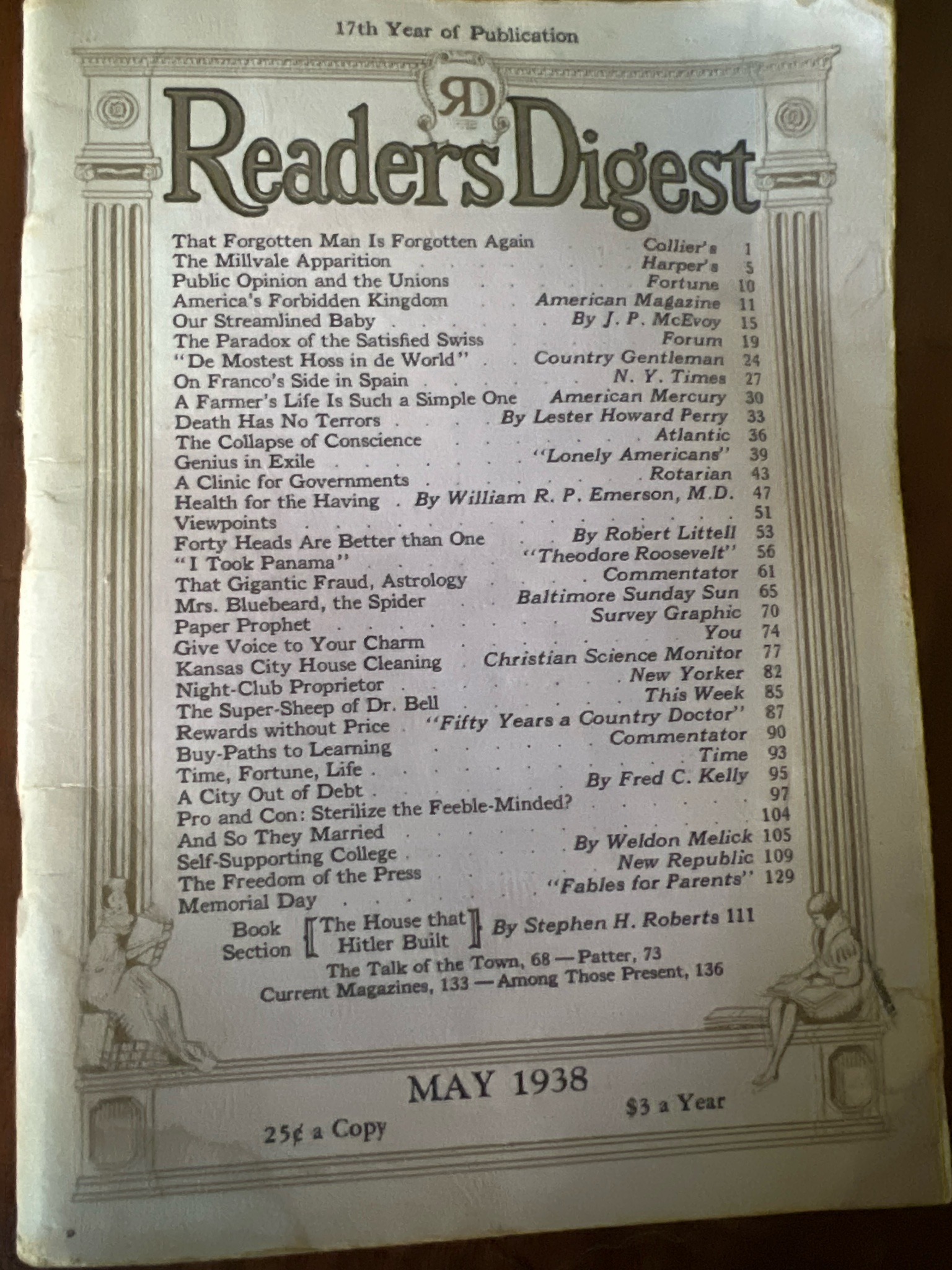
Reader's Digest Magazine - May 1938 Issue

Vintage Periodicals and Collectible Magazines

AI Estimated Value

·Not an official valuation·Verify before acting

$15 - $25

As of May 28, 2026

AI Item Analysis

·AI can make mistakes·Verify before acting
This is an original May 1938 issue of Reader's Digest, marked as the 17th Year of Publication. The magazine features the classic early-style cover design, characterized by a detailed architectural border with fluted columns and a pediment, rendered in a monochrome sepia or light-brown ink on off-white paper. At the bottom corners are decorative illustrations of individuals reading. The front cover serves as the table of contents, listing diverse articles from publications such as Fortune, Harper's, and Atlantic, as well as a book section titled 'The House that Hitler Built' by Stephen H. Roberts. The price is listed as 25 cents a copy or $3 a year. Physically, the item shows significant signs of age and wear appropriate for a publication over 80 years old. There is visible creasing on the left side and top-right corner, along with minor chipping and darkening of the paper edges (foxing). The spine appears to be intact but shows stress marks. This issue represents a significant period in pre-WWII history, containing articles that reflect the social and political anxieties of the late 1930s. The typography and layout are quintessential of the era's utilitarian yet formal aesthetic.


AI Appraisal Report

·AI can make mistakes·Verify before acting
Based on my visual examination of this May 1938 issue of Reader's Digest, I have assessed its value within the current market for vintage mass-market periodicals. The item appears to be an authentic original, displaying a period-accurate monochrome architectural border and the specific table of contents consistent with the 17th year of publication. Authenticity is supported by the vintage-specific typography and the presence of the book section 'The House that Hitler Built,' which was a notable 1937/1938 release. The condition is graded as 'Fair to Good.' I observed significant structural wear, including creasing, edge-chipping, and foxing (acidification) of the paper consistent with high-acid pulp typical of the era. The spine shows notable stress, though the binding remains functional. Market demand for early Reader's Digest issues is relatively low because of the massive circulation volumes of the time; they are considered historical curiosities rather than rare collectibles. While the pre-WWII content adds thematic interest to collectors of 20th-century history, the lack of a celebrity cover or a 'first issue' status prevents it from reaching higher price tiers. Comparison with recent sales of late-1930s issues in similar condition confirms a valuation in the $15 to $25 range. Note that this appraisal is based on photographic evidence. A full authentication would require an in-person inspection to verify paper scent, ink absorption, and 'suppleness' of the inner pages to check for brittle-paper syndrome. Scientific fiber analysis or provenance documentation from the original subscriber would be necessary to rule out high-quality modern reproductions, although the low market value makes counterfeiting unlikely.

Get your items appraised

Instant estimates of your treasures with AI-powered appraisals

Browse More Appraisals