AI estimate as of August 23, 2025 · verify with a professional before acting
AI-Generated · Verify before acting
Everything on this page is generated by AI for informational purposes only. AI can make mistakes — the AI may misidentify items or misattribute them (artist, maker, brand, designer, origin, era). This is not an official valuation and should not be used for insurance, sale, tax, estate, legal, or lending purposes — or any decision requiring a certified appraisal. It is not an authoritative claim about any person, brand, or rights holder — do not share or rely on it as a factual statement about a third party. Always consult qualified professionals before making financial decisions.
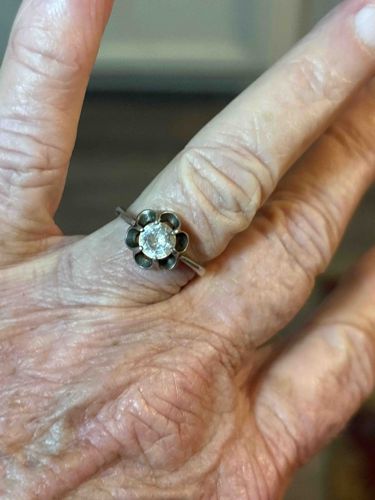
This is a vintage or antique ring featuring a central round, faceted gemstone set within a distinctive floral-inspired bezel. The ring appears to be crafted from a silver-toned metal, possibly silver, white gold, or platinum, given its color and apparent resistance to tarnishing that would be typical of costume jewelry. The central stone is somewhat cloudy or appears to have inclusions, consistent with an older cut diamond (e.g., Old European Cut or Old Mine Cut) or perhaps a white sapphire or topaz. Its facets are visible, and it exhibits some sparkle. The most notable feature is the bezel setting, which is designed as an eight-petaled flower, with each petal having a slightly cupped or raised edge, creating a dimensional look. The metal surrounding the stone and forming the petals shows a dark patina or intentional oxidation within the crevices, which highlights the floral design and provides a contrast against the polished edges. This darkening could be natural age-related tarnishing or an applied finish to enhance detail. The band of the ring is thin and simple, suggesting that the focus is entirely on the decorative head. There are no visible maker’s marks or hallmarks in the provided image. The overall style suggests a piece from the early to mid-20th century, possibly Edwardian or Art Deco era due to the floral motif and the type of stone setting. The craftsmanship appears solid, though details like prong security and band integrity would need a closer inspection for a full assessment. The general condition appears good for its age, showing some signs of wear consistent with regular use, but no obvious significant damage such as bent components or missing stones.
AI Appraisal Report
Upon visual examination of this Floral Bezel Set Solitaire Ring, I note its distinctive vintage appeal. The central stone, likely an older cut diamond (Old European or Old Mine Cut), white sapphire, or topaz, is somewhat cloudy, which could be oxidation or minor inclusions. Its visible facets suggest good light return. The most captivating feature is the innovative eight-petaled floral bezel in a silver-toned metal, possibly platinum or white gold, given its luster. The intentional darkening within the crevices highlights the intricate floral design, enhancing its dimensionality and vintage aesthetic. The band is thin and simple, thoughtfully directing all attention to the decorative head. The overall condition appears good for its age, showing typical wear consistent with its likely period from the early to mid-20th century.
In terms of market conditions, vintage floral-themed pieces, especially those with unique settings, currently enjoy steady demand. Their rarity is moderate; while many floral rings exist, this specific cupped-petal bezel design is less common. Factors significantly impacting value include the precise identity and quality of the central stone, the metal composition (platinum or 18k white gold would be more valuable than 10k gold or silver), and the age/provenance. Currently, there is a strong demand for unique antique/vintage rings compared to mass-produced contemporary designs.
It is crucial to acknowledge the limitations of appraising from an image. I cannot definitively assess the internal characteristics of the stone (clarity, color, exact carat weight), which are critical for its value. Without in-person examination, I cannot confirm the metal type through hallmarks or testing, nor can I thoroughly check structural integrity (e.g., potential micro-fractures, secure stone setting). A gemological assessment of the stone, X-ray fluorescence (XRF) for metal composition, and a detailed inspection for hallmarks and structural soundness would be essential for a precise valuation.