These notes were written by the person who submitted this item. Appraiser.AI has not verified them, and the AI's identification and estimate may rely on them.
AI Estimated Value
Not an official valuation
$300-500
AI estimate as of August 31, 2025 · verify with a professional before acting
AI-Generated · Verify before acting
Everything on this page is generated by AI for informational purposes only. AI can make mistakes — the AI may misidentify items or misattribute them (artist, maker, brand, designer, origin, era). This is not an official valuation and should not be used for insurance, sale, tax, estate, legal, or lending purposes — or any decision requiring a certified appraisal. It is not an authoritative claim about any person, brand, or rights holder — do not share or rely on it as a factual statement about a third party. Always consult qualified professionals before making financial decisions.
This analysis also relies on unverified notes provided by the user, which may be incomplete or inaccurate and could affect the result.
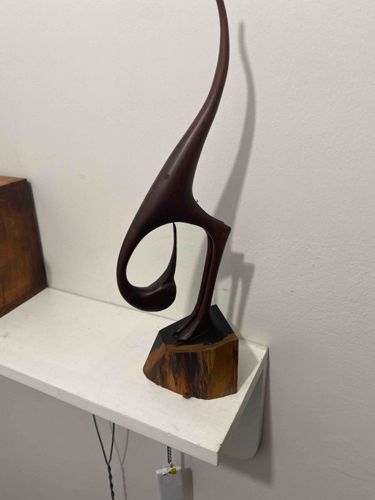
This is a modern abstract sculpture, likely intended as a decorative ornament. The primary component of the sculpture is a dark, reddish-brown wood, possibly mahogany or a similarly dense hardwood, which has been highly polished to a smooth, lustrous finish. The form is highly curvilinear and organic, featuring slender, elongated curves that sweep upwards, suggesting movement or a stylized natural form, perhaps a bird or a flame. One prominent feature is a negative space or 'window' within the body of the sculpture, enhancing its abstract quality. The sculpture is mounted on a separate, irregularly shaped wooden base with a more naturalistic, lighter wood grain, featuring visible growth rings and a rough-hewn, unfinished appearance on its sides. The top surface of this base is dark, matching the sculpture itself, suggesting it might be stained or painted to create a cohesive bond. The craftsmanship appears to be high quality, with seamless curves and a well-executed finish, indicating skilled carving and polishing. There are no visible condition issues such as cracks, chips, or significant wear. No maker's marks or signatures are discernible from the image. Its style suggests a mid-20th century to contemporary period, aligning with biomorphic or organic modern art movements. The contrast between the sleek, dark, abstract form and the rustic, natural base creates an interesting visual dynamic, highlighting both modern design and natural elements.
AI Appraisal Report
Based on my visual examination of the provided image, this Abstract Carved Wood Sculpture appears to be in excellent condition. The highly polished, dark wood shows no visible signs of cracks, chips, or significant wear. The craftsmanship, with its seamless curves and smooth finish, suggests a high level of skill. The authenticity, however, is limited by my inability to conduct a physical inspection. Without maker’s marks or signatures visible, and without handling the piece, I cannot definitively attribute it to a specific artist or workshop.
In terms of market conditions, abstract biomorphic wood sculptures, particularly those from the mid-20th century to contemporary period, generally see steady demand. Comparables in the secondary market, especially un-attributed pieces of similar size and quality, typically fall within the decorative arts category rather than fine art. While its aesthetic appeal is strong, the lack of artist provenance significantly impacts its potential value, preventing it from reaching higher price points reserved for known artists.
Key value factors include its excellent condition, appealing abstract form, and the apparent quality of materials and craftsmanship. The contrast between the sleek sculpture and the rustic base adds visual interest. However, the absence of an identifiable artist or clear provenance is the primary limiting factor for its value.
For full authentication, an in-person examination would be crucial to assess the wood type definitively, scrutinize the carving techniques, and search for any hidden marks. Provenance documentation (e.g., bills of sale, exhibition records) would establish its history, and scientific testing (e.g., carbon dating for precise age determination or wood analysis) could offer further insights. Without these, the appraisal remains based on visual aesthetic and general decorative market comparables.