These notes were written by the person who submitted this item. Appraiser.AI has not verified them, and the AI's identification and estimate may rely on them.
AI Estimated Value
Not an official valuation
$40-65
AI estimate as of December 8, 2025 · verify with a professional before acting
AI-Generated · Verify before acting
Everything on this page is generated by AI for informational purposes only. AI can make mistakes — the AI may misidentify items or misattribute them (artist, maker, brand, designer, origin, era). This is not an official valuation and should not be used for insurance, sale, tax, estate, legal, or lending purposes — or any decision requiring a certified appraisal. It is not an authoritative claim about any person, brand, or rights holder — do not share or rely on it as a factual statement about a third party. Always consult qualified professionals before making financial decisions.
This analysis also relies on unverified notes provided by the user, which may be incomplete or inaccurate and could affect the result.
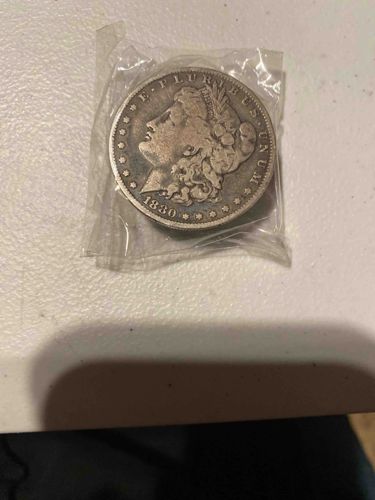
The item is an apparent 1880 Morgan Silver Dollar, specifically showing the obverse side of the coin. It is housed within a clear, soft plastic protective sleeve or flip, which is slightly crinkled, indicating some wear to the packaging. The coin itself appears to be made of silver, consistent with the composition of Morgan dollars (90% silver, 10% copper), and exhibits a metallic, somewhat dulled silver-grey color with areas of darker toning, suggesting some natural oxidation over time. The design prominently features the left-facing profile of Lady Liberty, adorned with a Phrygian cap, a wreath of wheat and cotton, and a headband inscribed with 'LIBERTY'. Above her head, the motto 'E PLURIBUS UNUM' is visible, partially obscured by the plastic. Below Liberty's bust, the mint date '1880' is clearly legible, surrounded by thirteen stars, representing the original thirteen colonies. The denticles (small tooth-like projections) around the rim are mostly intact, though some appear slightly softened due to wear. The overall condition of the coin, as viewed through the plastic, suggests a circulated state, with some loss of fine detail in Liberty's hair and the high points of her facial features. There are no obvious deep scratches, gashes, or significant corrosion visible, but surface marks consistent with handling and circulation over many years are present. The craftsmanship is consistent with U.S. Mint coinage of the late 19th century, known for its intricate design details. The protective sleeve, while functional, does not appear to be archival quality, which could impact the long-term preservation of the coin.
AI Appraisal Report
Upon examining the provided image of what appears to be an 1880 Morgan Silver Dollar (Obverse), I can offer an appraisal based on visual assessment. The coin presents as authentic, exhibiting the characteristic design elements of a Morgan dollar: Lady Liberty with her Phrygian cap, wheat and cotton wreath, and the legible date '1880' (which is a common date for this series and appears to be from the Philadelphia mint, indicated by the absence of a mint mark). The denticles are mostly present, and the overall metallic appearance with some toning is consistent with an uncleaned, circulated silver coin of this age.
From the image, the coin's condition appears to be in the Fine (F) to Very Fine (VF) range. There is evident wear on Liberty's hair, cheekbone, and the higher points of the design, consistent with circulation. However, key details like the letters in 'LIBERTY' on the headband and the stars are still reasonably strong. There are no major detractions visible such as deep scratches, dings, or signs of improper cleaning, which would significantly diminish its value. The protective sleeve is soft plastic and crinkled, which is not ideal for long-term preservation but does not directly impact the coin's current condition.
Market conditions for 1880 Morgan Dollars are generally strong, but this date is not considered rare. Demand is consistent among collectors, especially for examples in higher grades. Comparables in similar circulated condition (F-VF) typically trade in the $40-$65 range. Rarity is low due to a mintage of over 27 million for the Philadelphia mint in 1880. Factors impacting this value are primarily the circulated state. An uncirculated example would command significantly more.
It is crucial to note that this appraisal is based solely on the provided image. Limitations exist when verifying authenticity from photographs alone. A physical examination would allow me to critically assess the coin's luster, exact strike quality, and detect any potential alterations, counterfeit markers, or more subtle surface issues that cannot be fully appreciated through a digital image or a plastic holder. Furthermore, without the reverse of the coin, I cannot confirm the mint mark. For full authentication, in-hand inspection by a professional numismatist or submission to a third-party grading service (like PCGS or NGC) would be recommended.