These notes were written by the person who submitted this item. Appraiser.AI has not verified them, and the AI's identification and estimate may rely on them.
AI Estimated Value
Not an official valuation
$40 - $70
AI estimate as of December 8, 2025 · verify with a professional before acting
AI-Generated · Verify before acting
Everything on this page is generated by AI for informational purposes only. AI can make mistakes — the AI may misidentify items or misattribute them (artist, maker, brand, designer, origin, era). This is not an official valuation and should not be used for insurance, sale, tax, estate, legal, or lending purposes — or any decision requiring a certified appraisal. It is not an authoritative claim about any person, brand, or rights holder — do not share or rely on it as a factual statement about a third party. Always consult qualified professionals before making financial decisions.
This analysis also relies on unverified notes provided by the user, which may be incomplete or inaccurate and could affect the result.
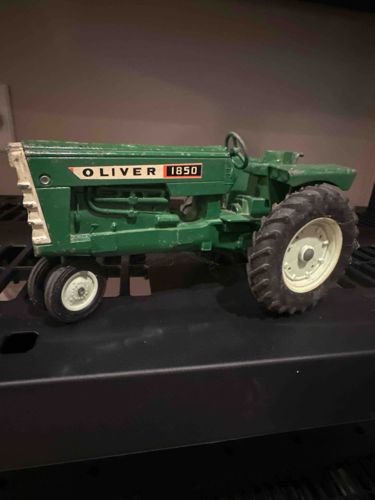
This item is a die-cast or cast iron replica of an Oliver 1850 tractor, presented in a prominent shade of olive green with white accents. The tractor features detailed casting work, including engine components and body panels, indicative of a collectible toy or model. The 'OLIVER' name is clearly visible in white lettering on the side, accompanied by '1850' in a white box with a black border, suggesting the specific model it represents. The wheels are painted white, contrasting with the black rubberized tires which show tread patterns. The steering wheel is also visible on the right side. The overall condition appears to be good with some minor paint chipping visible on the front grille and possibly other areas due to handling or age. There are no obvious signs of significant damage like breaks or deep scratches, but surface dust is present, particularly on the tires and the body. The white painted sections, especially on the front grille and wheels, show some yellowing or discoloration from age. The item demonstrates reasonable quality in its construction and detailing, typical of collectible farm toy models from the mid-20th century. Based on the Oliver 1850's production years (1964-1970), this toy likely dates from that era or shortly thereafter, placing its estimated age in the late 1960s to 1970s. No specific manufacturer's marks are visible in the provided image, but such models were commonly produced by companies like Ertl or Scale Models.
AI Appraisal Report
I have examined the provided image of the Oliver 1850 Toy Tractor. Visually, this appears to be a die-cast or cast iron replica, characteristic of collectible farm toys. The olive green color with white accents and the clear 'OLIVER 1850' branding are consistent with models of this specific tractor. The visible detailing, including engine components and tire treads, suggests a reasonable quality of manufacturing for its type. The condition is good overall, with minor paint chipping on the front grille and surface dust, indicating normal use or display. Some yellowing or discoloration on white painted areas is also present, consistent with age. This item likely dates from the late 1960s to 1970s, aligning with the Oliver 1850's production years.
Market conditions for vintage farm toys are generally stable, with specific brands and models holding varying interest. While Oliver tractors have a dedicated collector base, the 1850 model in this condition is not considered exceptionally rare. Manufacturers like Ertl were prolific producers of such toys, and without visible maker's marks, it's difficult to pinpoint the exact producer, which can sometimes influence value. Demand is moderate for common models in good, but not pristine, condition. Factors impacting value here include the good, but not mint, cosmetic state and the absence of original packaging or any unique features. Significant damage like breaks or missing parts would drastically reduce value, but these are not present.
Limitations in authenticity verification from images alone are notable. I cannot confirm the exact material composition (die-cast vs. cast iron) or the manufacturer without physical inspection. An in-person examination would allow for a tactile assessment of the material, a thorough check for hidden damage, and the identification of any manufacturer's marks or serial numbers. Provenance documentation, such as original sales receipts or family history, could also enhance authenticity and value, particularly for rarer variants. Scientific testing is not typically required for this type of item.