AI estimate as of August 2, 2025 · verify with a professional before acting
AI-Generated · Verify before acting
Everything on this page is generated by AI for informational purposes only. AI can make mistakes — the AI may misidentify items or misattribute them (artist, maker, brand, designer, origin, era). This is not an official valuation and should not be used for insurance, sale, tax, estate, legal, or lending purposes — or any decision requiring a certified appraisal. It is not an authoritative claim about any person, brand, or rights holder — do not share or rely on it as a factual statement about a third party. Always consult qualified professionals before making financial decisions.
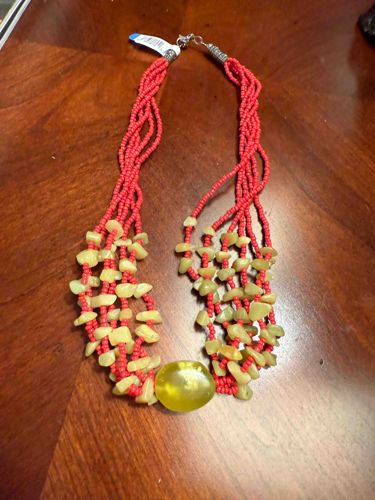
This is a multi-strand beaded necklace, approximately 18-20 inches in length, featuring a striking combination of red glass seed beads and light yellow/chartreuse polished gemstone chips. The necklace is composed of multiple individual strands (at least 5-6 appear visible on each side) of small, uniform red seed beads that are twisted together to form the main body of the necklace. These red strands are interspersed with cascades of the yellowish gemstone chips. Each chip is irregularly shaped, indicating a natural material that has been tumbled or polished rather than faceted, and they vary slightly in size and hue, adding to the organic feel of the piece. The chips are attached to separate, thinner red bead strands that hang down from the main twisted sections. At the center of the necklace, a prominent, large, smooth, polished oval or rounded cabochon-style bead, matching the light yellow/chartreuse color of the smaller chips, serves as a focal point. It has a slightly translucent quality, allowing light to pass through and highlight its internal characteristics, possibly inclusions. The necklace is secured with a silver-toned lobster clasp and a jump ring, accompanied by a small extension chain. There are metal bead caps with an etched or decorative pattern where the multiple strands converge near the clasp, indicating some attention to finishing details. A white tag with a blue stripe, likely a price or identification tag, is visible near the clasp, suggesting it may be a new or recently acquired item from a retail setting. The overall condition appears good with no obvious signs of wear, chips, or damage to the beads or clasp. The craftsmanship suggests a bohemian or ethnic-inspired style, possibly from the late 20th or early 21st century.
AI Appraisal Report
I have carefully examined the provided image of this multi-strand red seed bead and yellow stone chip necklace. Based on visual assessment, the condition appears excellent, with no visible damage to beads, chips, or the clasp. The construction, featuring multiple twisted red seed bead strands interspersed with irregular yellow gemstone chips, points to a bohemian or artisanal style. The large, smooth cabochon pendant, matching the chip color and exhibiting translucency, is a nice focal point. The silver-toned lobster clasp and decorative metal bead caps suggest a commercially produced piece, likely late 20th or early 21st century. The white tag visible near the clasp indicates it may be a new or retail item.
From a market perspective, comparable items, often described as 'chip stone necklaces' or 'bohemian multi-strand necklaces' using glass beads and natural stone chips, typically fall within the affordable fashion jewelry category. While the natural stone chips (likely citrine, serpentine, or similar) add some intrinsic value over purely glass, they are common materials. Demand for this style is generally consistent, but it is not rare.
Factors significantly impacting value include the materials, craftsmanship, and overall design appeal. The use of natural stone chips elevates it above pure costume jewelry, but the modest materials and mass-produced feel (indicated by the clasp and bead caps) limit its high-end value. Without hallmarks, the metal quality of the clasp cannot be determined. The primary value drivers are aesthetic appeal and material cost rather than rarity or preciousness.
Limitations: Authenticity verification of the stone type (beyond visual identification as natural stone) would require in-person inspection and possibly gemological testing. Verification of the metal content of the clasp is impossible from images. Full authentication of the gemstone identity and origin, and confirming if the beads are truly glass versus plastic (though they appear glass), would necessitate physical examination and scientific analysis. Provenance documentation would be needed to establish any designer or artisan connection, which is not evident here.