AI estimate as of December 11, 2025 · verify with a professional before acting
AI-Generated · Verify before acting
Everything on this page is generated by AI for informational purposes only. AI can make mistakes — the AI may misidentify items or misattribute them (artist, maker, brand, designer, origin, era). This is not an official valuation and should not be used for insurance, sale, tax, estate, legal, or lending purposes — or any decision requiring a certified appraisal. It is not an authoritative claim about any person, brand, or rights holder — do not share or rely on it as a factual statement about a third party. Always consult qualified professionals before making financial decisions.
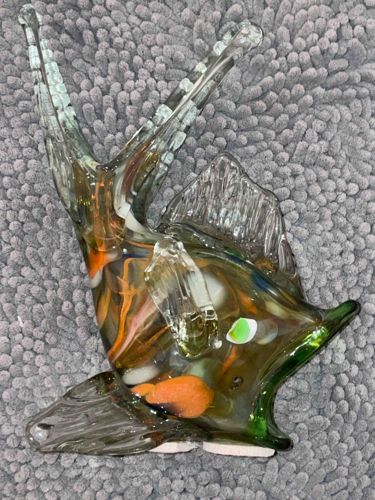
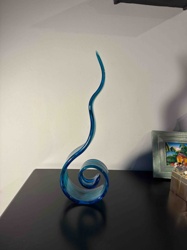
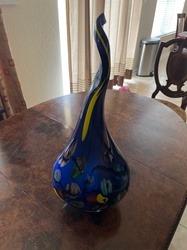
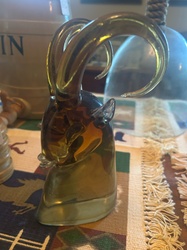
This is a decorative art glass sculpture depicting a stylized sailfish, likely crafted in the Murano style. The piece is characterized by its dynamic form, capturing the essence of the fish in motion with its prominent dorsal fin and elongated bill. The primary material is glass, exhibiting a variety of colors and techniques. The body features internal swirls of white, orange, and darker hues, suggesting an 'aventurine' or 'sommerso' effect where layers of colored glass are encased. The fins, particularly the large dorsal fin and what appears to be the tail, are made of clear glass with textured, ridged surfaces that mimic the natural appearance of fish fins. The bill of the sailfish is also clear glass, tapering to a point. A striking feature is the eye, comprised of a white disk with a vivid green circular pupil, adding a focal point to the abstract body. The base of the sculpture, which is not fully visible but appears to be a flat, polished area, provides stability. The overall craftsmanship suggests hand-blown or lampworked glass, given the organic shapes and integrated color work. There are no visible chips, cracks, or repairs, and the glass appears to be in good condition with a clean surface, indicating minimal wear or handling. Without a visible maker's mark or signature, attributing it definitively to a specific Murano maker or period is challenging, but the style is consistent with decorative glass produced in the mid to late 20th century. The intricate color mixing and delicate formation of the fins highlight a moderate to high level of glassblowing skill.
AI Appraisal Report
Based on my visual examination of the provided image, this Murano Style Art Glass Sailfish Sculpture appears to be in excellent condition. I observe no chips, cracks, or repairs, and the glass surfaces exhibit a clean, well-maintained appearance. The vibrant internal coloration, including what looks like aventurine or sommerso effects, is well-preserved, and the clear glass fins and bill maintain their integrity. Given the organic forms and integrated color work, it strongly suggests hand-blown or lampworked craftsmanship.
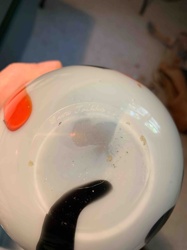
Authenticity, specifically attribution to a Murano studio, is challenging to confirm solely from images. While the style, coloration, and quality of glassblowing are consistent with decorative art glass produced in Murano in the mid to late 20th century, the absence of a visible maker's mark or signature prevents a definitive attribution. Many high-quality decorative glass pieces were produced in the Murano region without explicit signatures, or with paper labels that have since been lost.
In terms of market conditions, decorative art glass, particularly abstract or stylized animal forms, experiences consistent but not extraordinarily high demand. Pieces like this appeal to collectors of mid-century decor and art glass enthusiasts. Comparable unsigned Murano-style animal sculptures of similar size and complexity typically retail in the $200-$500 range, with signed examples or those from highly sought-after studios commanding significantly higher prices. The perceived quality of craftsmanship and the vibrant, attractive aesthetic contribute positively to its value.
Factors impacting value include the excellent condition, the appealing design, and what appears to be skilled glasswork. However, the lack of a verifiable signature is the primary limiting factor in achieving a higher valuation. To fully authenticate and potentially enhance its value, an in-person examination would be crucial to inspect for subtle etchings, pontil marks, and the overall quality of the glass and construction that may not be apparent in photographs. Provenance documentation, if available, would also be invaluable. Without these, I'm confident in assessing its current market value in the range of $250-400.