AI estimate as of July 26, 2025 · verify with a professional before acting
AI-Generated · Verify before acting
Everything on this page is generated by AI for informational purposes only. AI can make mistakes — the AI may misidentify items or misattribute them (artist, maker, brand, designer, origin, era). This is not an official valuation and should not be used for insurance, sale, tax, estate, legal, or lending purposes — or any decision requiring a certified appraisal. It is not an authoritative claim about any person, brand, or rights holder — do not share or rely on it as a factual statement about a third party. Always consult qualified professionals before making financial decisions.
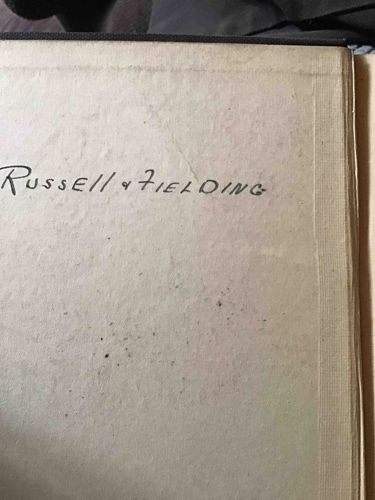
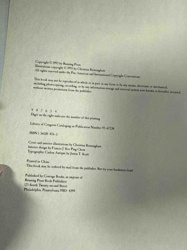
The item appears to be an old book, specifically an endpaper or flyleaf, which is the blank page immediately inside the cover. The page is made of a cream or off-white paper, exhibiting characteristics of aged paper such as slight discoloration and possibly some foxing, which presents as small, dark spots scattered across the surface. These spots are visible as black specks, particularly in the lower central and right portions of the image, indicating potential mildew growth or metallic impurities in the paper reacting over time. The paper itself has a slightly textured appearance, consistent with older paper manufacturing processes. A notable feature is the handwritten inscription "RUSSELL & FIELDING" in cursive, dark ink, positioned towards the top left of the page. The handwriting style suggests a period before widespread use of typewriters, possibly early to mid-20th century or even late 19th century. The binding edge of the page on the right side shows clear vertical lines, indicating the spine where the pages are bound together, and the slight creasing or wear along this edge is typical of a book that has been opened and closed repeatedly. The top edge of the page is visible, showing a black or dark-colored material, which is likely the inside of the book's hardboard cover. No other specific manufacturing details like watermarks or printed marks are discernible from this image. The overall condition suggests moderate wear consistent with age and use, but without major tears or rips visible. The craftsmanship points to a traditionally bound volume, the quality of which would be further determined by examining the cover, other pages, and the content.
AI Appraisal Report
Upon examining the image of this old book endpaper with the inscription "RUSSELL & FIELDING," I assess its condition as moderately worn, consistent with its age and use. The slight discoloration, foxing (small dark spots), and creasing along the binding edge are typical for a book of considerable age. The handwriting appears authentic, indicative of an inscription made directly in the book, likely late 19th to early 20th century. Authenticity of the inscription itself, meaning whether it's truly historical or a modern addition, is difficult to definitively confirm from an image alone. The quality of the paper and the binding edge suggest a traditionally bound volume.
From a market perspective, a single endpaper, even with an inscription, generally holds limited standalone value unless the inscription is by a historically significant person, a well-known author, or relates to a major historical event. Without knowing the full book's content, its author, or the identity of "Russell & Fielding," the intrinsic value is primarily decorative or as a curiosity. The market for generic inscribed endpapers is niche and not highly liquid. Comparable items, such as generic antique book ephemera, often command low values, typically under $50. Demand for such an item is low, and it is not inherently rare without further historical context. Factors that would significantly impact value, such as a famous author's signature, original provenance, or the book's content, are unknown. For full authentication and a more precise valuation, I would require in-person examination to assess paper quality, ink composition, and determine if it's indeed an original endpaper. Provenance documentation connecting "Russell & Fielding" to any significant historical figure would be crucial. Without this, it's speculative.