Vintage Drop-Leaf Butterfly Table
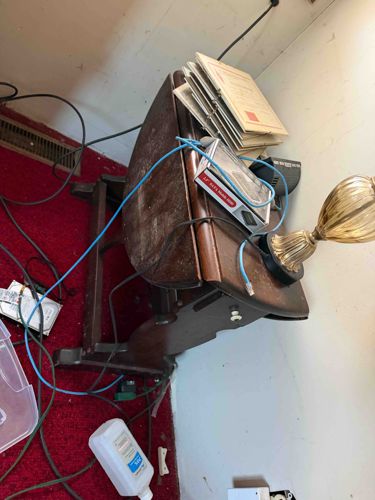
This is a vintage drop-leaf 'butterfly' occasional table, likely dating from the mid-20th century (circa 1930s-1950s), constructed in a Colonial Revival style. The piece is crafted from solid wood and finished in a deep dark mahogany or walnut stain. It features an oval-shaped top when fully extended, consisting of a fixed rectangular center leaf flanked by two semi-oval drop leaves supported by swing-out 'butterfly' brackets. The base is an American trestle style with two wide, flat vertical supports (piles) ending in shaped shoe feet, connected by a lower stretcher for stability. The top edges are simple and rounded. In terms of condition, the piece shows significant neglect and environmental wear. There is heavy dust accumulation across all surfaces, visible surface scratches, and potential water rings or finish clouding on the top. The dark finish appears to have faded or thinned in high-wear areas, particularly along the top edges. No obvious maker's marks are visible in the current orientation. The craftsmanship appears to be of standard commercial grade for the era, utilizing sturdy joinery techniques typical of American furniture manufacturers of the mid-century period.
AI-Generated Appraisal Disclaimer
Estimated Value
$100 - $175
Basic Information
Category
Furniture
Appraised On
February 3, 2026
Estimated Value
$100 - $175
Item Description
This is a vintage drop-leaf 'butterfly' occasional table, likely dating from the mid-20th century (circa 1930s-1950s), constructed in a Colonial Revival style. The piece is crafted from solid wood and finished in a deep dark mahogany or walnut stain. It features an oval-shaped top when fully extended, consisting of a fixed rectangular center leaf flanked by two semi-oval drop leaves supported by swing-out 'butterfly' brackets. The base is an American trestle style with two wide, flat vertical supports (piles) ending in shaped shoe feet, connected by a lower stretcher for stability. The top edges are simple and rounded. In terms of condition, the piece shows significant neglect and environmental wear. There is heavy dust accumulation across all surfaces, visible surface scratches, and potential water rings or finish clouding on the top. The dark finish appears to have faded or thinned in high-wear areas, particularly along the top edges. No obvious maker's marks are visible in the current orientation. The craftsmanship appears to be of standard commercial grade for the era, utilizing sturdy joinery techniques typical of American furniture manufacturers of the mid-century period.
Related Tags
Get Your Items Appraised
Instant estimates of your treasures with AI-powered instant appraisals