AI estimate as of September 8, 2025 · verify with a professional before acting
AI-Generated · Verify before acting
Everything on this page is generated by AI for informational purposes only. AI can make mistakes — the AI may misidentify items or misattribute them (artist, maker, brand, designer, origin, era). This is not an official valuation and should not be used for insurance, sale, tax, estate, legal, or lending purposes — or any decision requiring a certified appraisal. It is not an authoritative claim about any person, brand, or rights holder — do not share or rely on it as a factual statement about a third party. Always consult qualified professionals before making financial decisions.
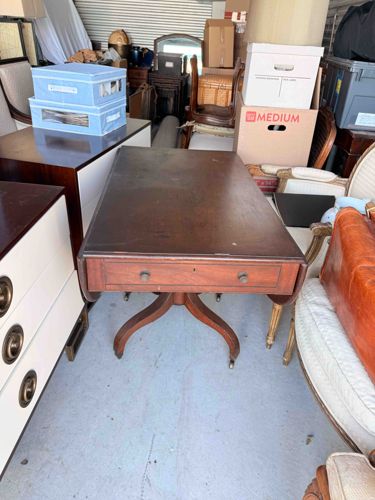
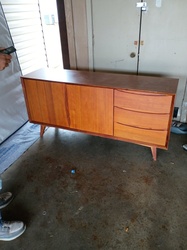
This appears to be a Federal style drop-leaf table, likely constructed from mahogany or a similar reddish-brown hardwood, exhibiting a rich, deep finish. The table features a rectangular top with two hinged drop leaves, which are currently in the extended position. When both leaves are up, the top forms a larger oval or elongated rectangular surface. The top shows significant signs of age and use, including visible scratches, scuffs, and areas where the finish may be worn or dulled, consistent with a well-loved antique; however, there are no immediate signs of major structural damage like cracks or breaks on the surface. The table is supported by a central turned pedestal, which branches out into four splayed legs. Each leg terminates in a caster, suggesting mobility was an intended feature, perhaps for use as a dining, serving, or occasional table. One single drawer is visible on one of the long sides, equipped with two small, possibly brass, knob pulls and a keyhole in the center, hinting at a locking mechanism for securing contents. The craftsmanship appears solid, typical of furniture from the late 18th to mid-19th century. The overall aesthetic points to an item of good quality, designed for both functionality and elegance, despite the apparent surface wear indicative of its age and history.
AI Appraisal Report
I have examined the provided image of this Federal Style Drop-Leaf Pedestal Table. Visually, the piece strongly aligns with Federal period furniture, likely mahogany or a similar rich hardwood, given the reddish-brown tone. The form – a drop-leaf top, central pedestal, splayed legs with casters, and a single drawer with knob pulls and a keyhole – is consistent with tables produced from the late 18th to mid-19th century in America. Condition-wise, it exhibits considerable surface wear, including scratches, scuffs, and dulled finish areas, all typical of a well-used antique of this age. Crucially, I see no immediate signs of major structural damage, which is a significant plus. The craftsmanship appears solid, indicative of good quality for its period.
Market conditions for Federal style furniture are generally stable, with a moderate demand for functional pieces like this. Comparables often include similar drop-leaf or tilt-top tables from the Federal or early Empire periods. The presence of a drawer adds practical value and charm. This style is not exceedingly rare, but well-preserved examples with original elements command respect. Factors impacting value include the desirable form, apparent structural integrity, and the likely original hardware (though this needs confirmation). The surface wear, while consistent with age, does place it in the mid-range rather than high-end for its type, as extensive refinishing can reduce originality.
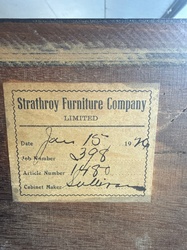
My primary limitation is relying solely on an image. Full authentication would require in-person examination to assess joint integrity, wood species, and verify the originality of the casters, drawer construction (e.g., dovetails), hardware, and finish. Provenance documentation (prior ownership history) would also immensely aid in confirming its authenticity and specific origin. Scientific testing for wood dating could provide definitive age confirmation if doubts arose. Without physical inspection, I cannot rule out the possibility of later alterations or repairs. Despite these limitations regarding absolute authentication, based purely on visual assessment, it presents as a genuine and functional antique with character.