AI Appraisal Estimate

AI-generated estimates · not official valuations

From the user

What was submitted

Photo and notes provided by the user — not generated by AI

Submitted item photo
Submitted photo · May 25, 2026

User's notes

No additional notes provided.

AI analysis below

AI appraisal

AI analysis & estimate

AI-Generated · Verify before acting

Everything below is generated by AI for informational purposes only. AI can make mistakes — the AI may misidentify items or misattribute them (artist, maker, brand, designer, origin, era). This is not an official valuation and should not be used for insurance, sale, tax, estate, legal, or lending purposes — or any decision requiring a certified appraisal. It is not an authoritative claim about any person, brand, or rights holder — do not share or rely on it as a factual statement about a third party. Always consult qualified professionals before making financial decisions.

Read the full disclaimer

AI Identification

·Not independently authenticated·Verify before acting

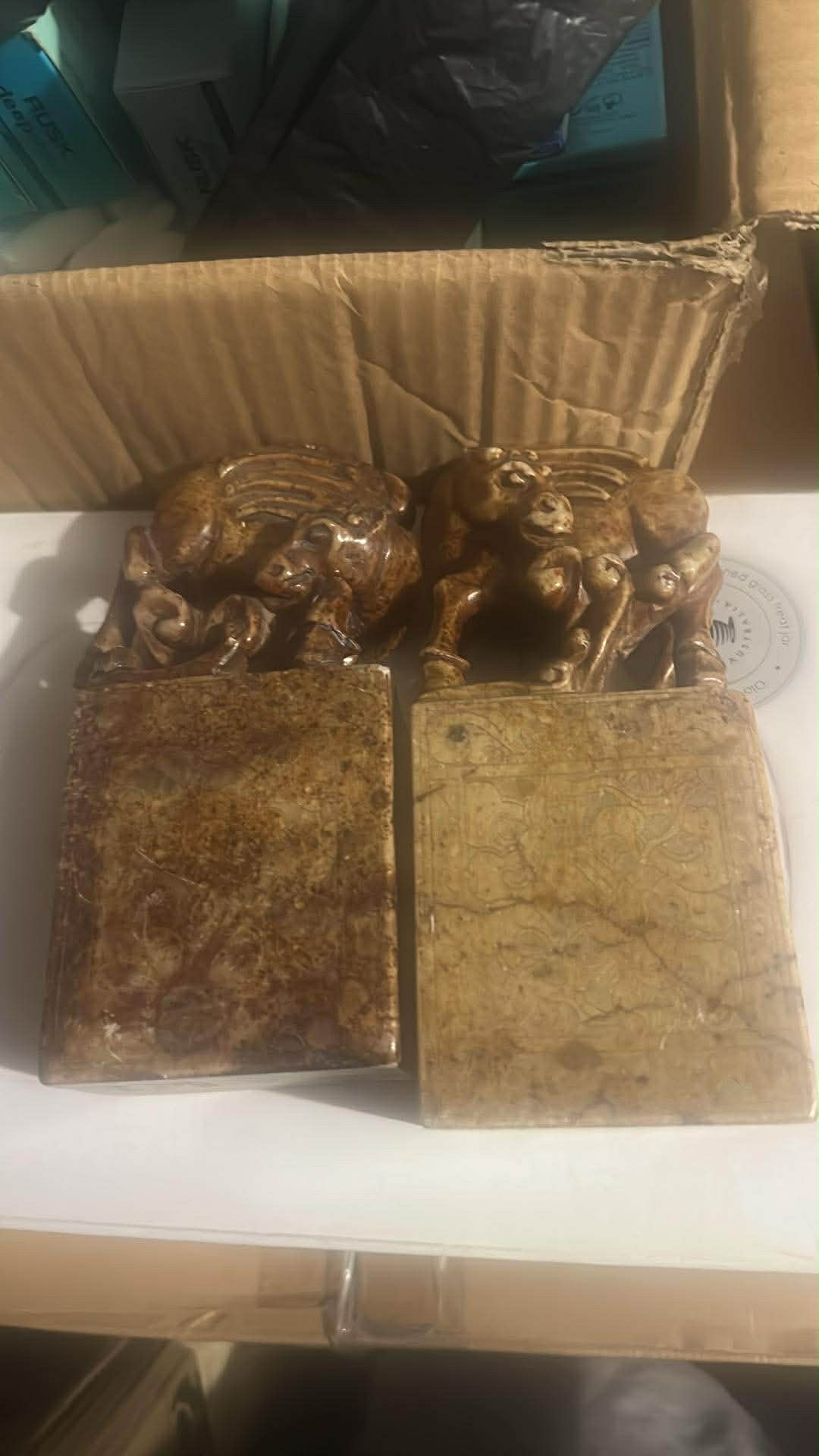
Pair of carved stone seal-style objects in the Chinese archaic manner

Decorative Arts

AI Estimated Value

·Not an official valuation·Verify before acting

$150 - $300

As of May 25, 2026

AI Item Analysis

·AI can make mistakes·Verify before acting
A pair of decorative carved stone objects appearing to be in the form of large square seals or desk weights. The objects feature figural finials carved in the shape of quadrupeds, possibly mythological creatures or horses, which are stylistically consistent with archaic Chinese jade or hardstone motifs. The stone exhibits varied coloration, with the left piece showing a dark reddish-brown mottled appearance and the right piece appearing in a lighter tan or celadon-colored stone with visible veining. The square bases feature incised line work around the upper edges, though the base surface of the right-hand object appears heavily weathered or deliberately distressed. The craftsmanship includes deep carving on the creatures and polished, flat surfaces on the pedestals. Visible condition issues include surface scratches, minor edge nicks, and significant variations in the stone's patina, which might suggest a simulation of age. Without an in-person physical inspection of the grain and hardness, it is not possible to identify the specific type of stone (such as jade, soapstone, or marble) or to verify the actual age of the pieces. The overall aesthetic is consistent with late 20th-century decorative interpretations of historical Chinese artifacts.
AI Appraisal Report

·AI can make mistakes·Verify before acting
Based on my visual analysis of the provided image, I have examined a pair of carved stone objects designed in the Chinese archaic style. From what I can see, these items function as decorative desk weights or faux seals, featuring mythological quadruped finials. While the carving shows some depth, the surface texture and 'weathered' patina on the bases appear consistent with late 20th-century decorative production rather than historical antiquity. I cannot verify from a photo whether the material is jade, soapstone, or a composite, as this would require a physical hardness test and examination of the grain structure. The value estimate of $150–$300 is based on the assumption that these are mid-to-late 20th-century decorative pieces. In the current market, there is steady demand for such 'Chinoiserie' objects as interior accents, though they do not command the high prices associated with period antiques. This valuation takes into account visible condition issues, including surface scratches and edge nicks. To determine a more precise identification or age, an in-person inspection by a specialist in Chinese lapidary arts would be necessary to evaluate the carving techniques and mineral composition. If these were hypothesized to be authentic archaic or dynastic-era artifacts, the value could increase significantly; conversely, if they are determined to be modern resin or mass-produced cast replicas, the value would likely fall below $50. Documentation of provenance or scientific testing of the stone would be required to shift from this decorative-grade attribution to a more significant historical classification.

Get your items appraised

Instant estimates of your treasures with AI-powered appraisals

Browse More Appraisals