AI Appraisal Estimate

AI-generated estimates · not official valuations

From the user

What was submitted

Photo and notes provided by the user — not generated by AI

Submitted item photo
Submitted photo · June 3, 2026

User's notes

No additional notes provided.

AI analysis below

AI appraisal

AI analysis & estimate

AI-Generated · Verify before acting

Everything below is generated by AI for informational purposes only. AI can make mistakes — the AI may misidentify items or misattribute them (artist, maker, brand, designer, origin, era). This is not an official valuation and should not be used for insurance, sale, tax, estate, legal, or lending purposes — or any decision requiring a certified appraisal. It is not an authoritative claim about any person, brand, or rights holder — do not share or rely on it as a factual statement about a third party. Always consult qualified professionals before making financial decisions.

Read the full disclaimer

AI Identification

·Not independently authenticated·Verify before acting

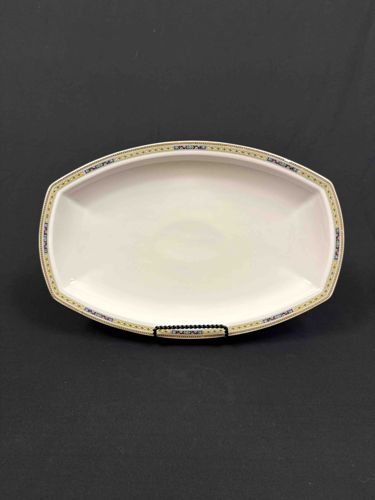
Vintage Oval Ceramic Serving Platter

Antique/Vintage Dinnerware

AI Estimated Value

·Not an official valuation·Verify before acting

$45 - $80

As of June 3, 2026

AI Item Analysis

·AI can make mistakes·Verify before acting
This is an elongated, octagonal-shaped ceramic serving platter with an off-white or cream-colored glazed finish. The platter features a distinct flat base with slightly flared sides that transition into a wide rim. The decorative border is a sophisticated neo-classical or Greek key inspired pattern, consisting of a thin beaded outer edge in a yellowish-gold tone, followed by an inner band with repeating blue geometric rectangular motifs against a pale yellow background. The construction appears to be high-quality ironstone or vitreous china, typical of mid-20th-century American or English manufacturers such as Homer Laughlin or Syracuse China. The glaze shows a consistent high-gloss sheen with no immediately visible crazing, chips, or major surface staining, suggesting well-maintained condition. The item rests on a modern black display stand, which is not part of the porcelain itself. The overall aesthetic suggests an Art Deco influence or a Traditional style common in fine dining sets of the 1930s through the 1950s. The elongated shape is specifically designed for serving main courses such as poultry, roast meats, or side vegetables, and the crispness of the transfer-printed border indicates a high standard of craftsmanship and industrial design quality for the era.
AI Appraisal Report

·AI can make mistakes·Verify before acting
Based on my visual examination of the provided image, this piece presents as a mid-20th-century ceramic serving platter, likely of American manufacturer origin, such as Homer Laughlin or Syracuse China. The design exhibits a refined geometric aesthetic typical of the late Art Deco to mid-century transitional period, featuring a distinctive Greek key-inspired blue geometric border on a pale yellow band. The condition appears to be 'Very Good' to 'Excellent,' with the glaze retaining a high-gloss sheen and no visible evidence of crazing, fractures, or heavy utensil marks on the primary serving surface, which is crucial for retaining resale value in vintage ironstone. The market for single serving platters from this era is steady but modest; values are highest when the specific pattern can be matched to complete an existing set. While the craftsmanship is consistent with quality vitreous china, this appears to be a mass-produced institutional or domestic ware rather than fine porcelain. Comparable sales for similar unbranded or common pattern ironstone platters from the 1930s-1950s generally fall in the $40 to $70 range, with slight premiums for pristine examples. It is important to note the limitations of an image-based appraisal. Without handling the item, I cannot inspect the maker's mark on the underside, which is the definitive method for confirming the manufacturer and exact production date. Furthermore, subtle hairline cracks or restoration work cannot be fully ruled out without tactile inspection or UV light analysis. If this piece bears a rare mark or belongs to a highly sought-after specific pattern line (like a rare restaurant ware commission), the value could increase slightly.

Get your items appraised

Instant estimates of your treasures with AI-powered appraisals

Browse More Appraisals