These notes were written by the person who submitted this item. Appraiser.AI has not verified them, and the AI's identification and estimate may rely on them.
AI Estimated Value
Not an official valuation
$600-900
AI estimate as of October 5, 2025 · verify with a professional before acting
AI-Generated · Verify before acting
Everything on this page is generated by AI for informational purposes only. AI can make mistakes — the AI may misidentify items or misattribute them (artist, maker, brand, designer, origin, era). This is not an official valuation and should not be used for insurance, sale, tax, estate, legal, or lending purposes — or any decision requiring a certified appraisal. It is not an authoritative claim about any person, brand, or rights holder — do not share or rely on it as a factual statement about a third party. Always consult qualified professionals before making financial decisions.
This analysis also relies on unverified notes provided by the user, which may be incomplete or inaccurate and could affect the result.
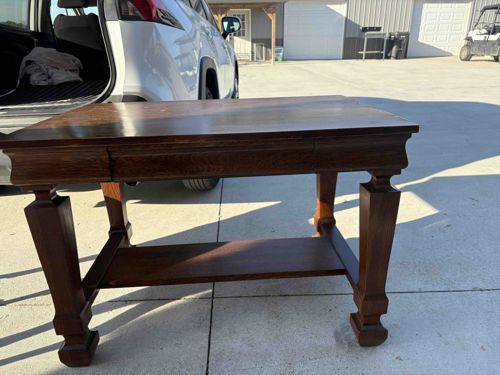
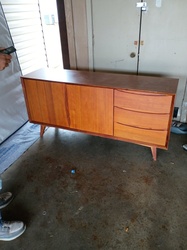
This is a substantial desk or library table, crafted from quarter-sawn oak, evident from the distinct ray flecks visible in the grain, which is a hallmark of this cutting technique. The wood is finished in a rich, dark brown stain with a semi-gloss sheen, suggesting a possible original finish or a sympathetic restoration. The tabletop is a solid, rectangular slab with a slightly rounded or softened edge profile. Below the tabletop, there is a deep apron, possibly containing a hidden or integrated drawer, as suggested by a vertical seam or line running across the front, implying a drawer front or two faux drawer fronts. The desk stands on four robust, turned legs; these legs feature a square block at the top and bottom, with a flared or tapered central section that includes a decorative ring turn or collar. The legs are connected by a lower stretcher shelf, adding stability and a practical storage or display surface. This shelf spans the width of the table, connecting the two pairs of legs, and is a solid piece of wood. The overall construction appears sturdy and well-made, indicating good craftsmanship. Visible condition issues include some minor surface wear on the tabletop, consistent with age and use, such as light scratches or scuffs, and possibly some fading of the finish in areas exposed to light. There are no obvious signs of major damage, repairs, or significant cracks. The style strongly suggests an Arts and Crafts or Mission period influence, likely dating from the late 19th to early 20th century. The clean lines combined with the robust construction and visible wood grain are characteristic of these periods, emphasizing functionality and natural materials. The significant weight and solid construction suggest this piece was built to last.
AI Appraisal Report
Based on my visual examination of the provided image, this quarter-sawn oak desk/library table presents as a robust and well-crafted piece, consistent with the Arts and Crafts or Mission style, likely dating from the late 19th to early 20th century. The distinct ray flecks confirm the quarter-sawn oak, a desirable feature of the period. The dark brown, semi-gloss finish appears appropriate, potentially original or a sympathetic restoration. Condition is good for its age; I observe minor surface wear on the tabletop, including light scratches or scuffs, which are acceptable and consistent with use. There are no overt signs of major damage, repairs, or structural issues. The 'seam' on the apron suggests either a functional drawer or faux drawer fronts, but without further visual information, this remains an assumption.
In terms of market conditions, similar quarter-sawn oak desks or library tables from the Arts and Crafts period are generally stable in value, appealing to collectors and those furnishing period homes. Comparables in good condition typically fetch in the $600-$1200 range, depending on maker, specific design, and condition. This piece, while a good example, does not exhibit features of a top-tier maker (e.g., Gustav Stickley) which would command higher prices. Demand is consistent, reflecting appreciation for authentic period craftsmanship. Rarity is moderate; while not unique, well-preserved examples are always sought after. The solid construction and quarter-sawn oak are significant value drivers.
My primary limitation in this appraisal is the lack of physical examination. While the visual indicators strongly support the dating and authenticity, an in-person inspection would allow me to physically assess the consistency of the finish, the structural integrity of joints, confirm wood species throughout, and definitively determine the presence and functionality of any drawers. Provenance documentation, though not available, would further enhance authenticity. Without scientific testing (e.g., carbon dating, although rarely practical for furniture of this period), my assessment of age relies on stylistic cues and material characteristics, which are very strong here.