AI estimate as of August 31, 2025 · verify with a professional before acting
AI-Generated · Verify before acting
Everything on this page is generated by AI for informational purposes only. AI can make mistakes — the AI may misidentify items or misattribute them (artist, maker, brand, designer, origin, era). This is not an official valuation and should not be used for insurance, sale, tax, estate, legal, or lending purposes — or any decision requiring a certified appraisal. It is not an authoritative claim about any person, brand, or rights holder — do not share or rely on it as a factual statement about a third party. Always consult qualified professionals before making financial decisions.
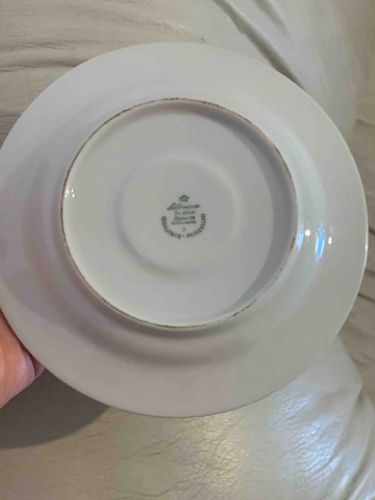
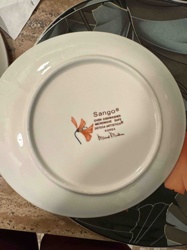
The item is the underside of a white ceramic or porcelain saucer, which appears to be part of a larger dinnerware set. It is circular in shape with a slightly raised rim on the underside, forming a foot ring that helps stabilize the piece and protects the glazed surface when stacked. The primary color is a clean, glossy white, indicative of fine porcelain or high-quality ceramic. The center of the underside features a green manufacturer's mark, which includes a crown emblem atop text that reads “Johann Seltmann,” "Weiden Bavaria", and what appears to be "Qualitats-Porzellan" or similar, indicating its origin and quality. There's also a number '4' or 'A' visible near the bottom of the mark. The surface shows some light wear, particularly around the foot ring and outer edge, possibly from stacking or regular use, evidenced by a slight dulling of the glaze and minimal scuffing. There are no obvious chips, cracks, or significant damage, suggesting it is in good used condition. The design suggests a classic, possibly mid-20th century, European style, characteristic of Bavarian porcelain manufacturers known for durable and elegant tableware. The craftsmanship appears to be of high quality, with a smooth finish and precise application of the maker's mark. The weight is not discernible but typical for a saucer of this type.
AI Appraisal Report
Based on my visual examination of the provided image, this Johann Seltmann Weiden Bavaria porcelain saucer appears to be in good, used condition. The surface presents a clean, glossy white, consistent with quality porcelain. I note minor wear around the foot ring and outer edge, likely from stacking or normal use, but no chips, cracks, or significant damage are visible. The green manufacturer's mark, including the crown and "Johann Seltmann Weiden Bavaria," seems authentic to the period, likely mid-20th century, and the presence of a number suggests an internal production mark. The craftsmanship appears consistent with Bavarian porcelain standards.
From a market perspective, individual saucers from open stock dinnerware, even by reputable manufacturers like Seltmann Weiden, typically command modest values unless part of a rare or highly sought-after pattern. Comparables for similar single saucers from this era generally fall within the $5-$15 range. Demand for individual saucers is low unless a collector is trying to complete a specific set. Rarity is also not a significant factor here; these were mass-produced items. The primary factor impacting value positively is its good condition; however, factors like its commonality and the fact that it's an individual piece rather than part of a set limit its market appeal and value.
It is important to state the limitations of this appraisal. Authenticity verification is based solely on the visual examination of the manufacturer's mark in the image. For full authentication, I would ideally need to conduct an in-person examination to assess the tactile quality of the porcelain, the weight, and to inspect the mark more closely for any inconsistencies not visible in a photograph. Provenance documentation, such as original sales receipts or family history, would also be beneficial but is rarely available for such items. Scientific testing, while possible for ceramic composition, is typically not practical or necessary for items of this value range.