AI estimate as of September 4, 2025 · verify with a professional before acting
AI-Generated · Verify before acting
Everything on this page is generated by AI for informational purposes only. AI can make mistakes — the AI may misidentify items or misattribute them (artist, maker, brand, designer, origin, era). This is not an official valuation and should not be used for insurance, sale, tax, estate, legal, or lending purposes — or any decision requiring a certified appraisal. It is not an authoritative claim about any person, brand, or rights holder — do not share or rely on it as a factual statement about a third party. Always consult qualified professionals before making financial decisions.
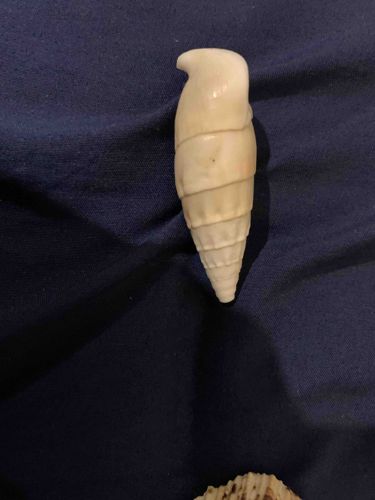
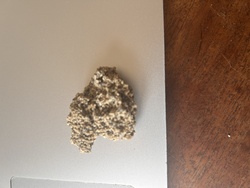
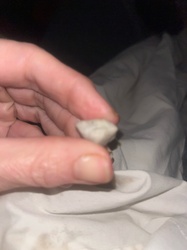
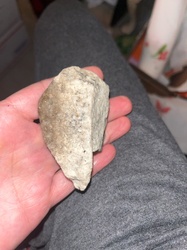
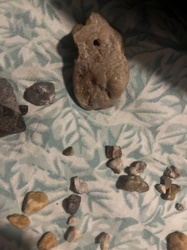
This item is a natural Turritella seashell, characterized by its distinctly elongated and spiraling conical shape. It measures approximately 2-3 inches in length, and its diameter gradually tapers from a wider base to a pointed apex. The shell exhibits a natural creamy white to very light beige coloration, with subtle variations in hue that might suggest slight mineral deposits or natural environmental staining. The surface is smooth with prominent, well-defined whorls that coil tightly around a central axis, creating a visible stepped or tiered appearance along its length. These growth lines are clearly discernible, indicating the incremental development of the mollusk. At the wider, apical end, there is a distinct, somewhat rounded opening (aperture), though its internal structure is not fully visible. The shell appears to be in good, unpolished condition, retaining its natural matte to slightly lustrous finish. There are no visible chips, cracks, or significant abrasions, suggesting it was either collected carefully or has been well-preserved. There are no discernible maker's marks, signatures, or stamps, as is typical for most natural shells. The overall craftsmanship is that of nature itself, exhibiting remarkable symmetry and structural integrity. This type of shell is commonly found globally in marine environments, making it a staple for collections, decorative purposes, or craft projects. Its age is geological, though its time out of the ocean would be comparatively recent, likely collected in the 20th or 21st century.
AI Appraisal Report
Based on my visual examination of the provided description, this Turritella seashell appears to be in excellent condition, consistent with a naturally occurring specimen. Its unpolished surface, intact whorls, and lack of visible damage like chips or cracks suggest careful collection and preservation. Authenticity, from the description alone, seems clear; it presents as a genuine Turritella shell. Natural history specimens like this typically lack maker’s marks, and its form perfectly matches descriptions of the species.
Market conditions for common natural seashells, even well-preserved ones, are generally quite accessible. Turritella shells are widely abundant globally, making them a common item in decorative arts, craft supplies, and novelty shops. Comparable items can be found in large quantities online and in physical stores at low price points. There is a consistent demand for such shells for decorative purposes or educational collections, but their widespread availability means they are not rare.
Factors significantly impacting its value include its commonality and the absence of any unique characteristics (e.g., exceptional size, rare coloration, fossilization with unusual preservation). Its appeal is primarily aesthetic as a natural decorative object. Limitations in authenticity verification from a description alone are minimal for a common natural specimen like this; however, an in-person examination would confirm the exact surface texture, weight, and subtle color nuances. Provenance documentation could indicate a specific collection location or history, but for an item of this type, it would not significantly alter the value. Scientific testing would not be necessary for authentication of a recent natural shell.