AI estimate as of August 31, 2025 · verify with a professional before acting
AI-Generated · Verify before acting
Everything on this page is generated by AI for informational purposes only. AI can make mistakes — the AI may misidentify items or misattribute them (artist, maker, brand, designer, origin, era). This is not an official valuation and should not be used for insurance, sale, tax, estate, legal, or lending purposes — or any decision requiring a certified appraisal. It is not an authoritative claim about any person, brand, or rights holder — do not share or rely on it as a factual statement about a third party. Always consult qualified professionals before making financial decisions.
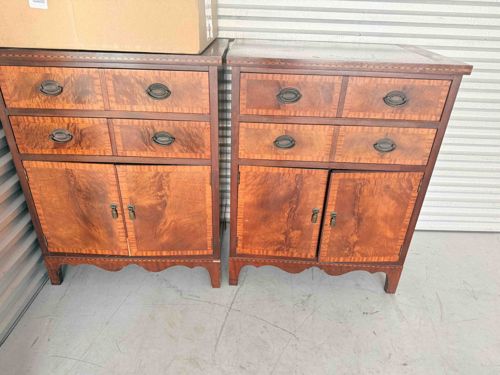
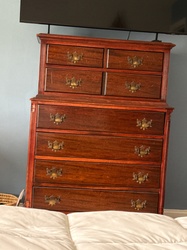
This is a pair of vintage American Federal or early 20th-century Georgian Revival style chest-on-stands or commodes. Each unit features a rich, reddish-brown wood, likely mahogany or a mahogany-stained wood, exhibiting a distinctive figured or flame grain veneer on the drawer and cabinet fronts, creating a visually striking pattern. The top surface of each piece, as well as the borders around the drawers and cabinet doors, feature a darker, possibly ebonized or stained wood with intricate light-colored inlay work, appearing to be a patterned stringing or cross-banding, lending an elegant accent to the pieces. Each chest has a configuration of four drawers on the upper section; the top row consists of two wider drawers, and the row below that also has two drawers, though slightly smaller. Below the drawers, there are two cabinet doors with brass or bronze drop pulls, matching the oval-shaped, bail-style pulls on the drawers. The hardware appears to have an aged patina, consistent with the age of the pieces. The construction suggests quality craftsmanship, with visible dovetail corners on the drawers (though not clearly visible in the provided image, typical for this style and period). The base of each unit features a delicate, scalloped apron with continuous inlay matching the top and drawer borders, supported by four short, slightly splayed bracket feet. There are no major visible condition issues such as cracks or significant chips, but minor wear, scuffs, and a consistent patina across both pieces are present, indicative of their age and use. The surfaces appear generally well-maintained, though some minor surface imperfections or fading might be present upon closer inspection. The absence of discernible maker's marks or signatures prevents specific attribution, but the style strongly points to a period of revivalist furniture, possibly from the late 19th or early to mid-20th century.
AI Appraisal Report
Based on my visual examination of the provided image, this is a handsome pair of Federal/Georgian Revival style commodes or chest-on-stands. The rich reddish-brown wood, likely mahogany or a stained equivalent, displays attractive flame grain veneer on the drawer and cabinet fronts, a desirable aesthetic. The intricately inlaid darker borders and scalloped apron elevate their elegance. The brass bail-style pulls and aged patina are consistent with pieces of this revivalist period.
Condition appears very good for their age; I observe only minor wear, scuffs, and a consistent patina, which are expected and contribute to their character. There are no obvious major flaws like cracks or significant chips. While I cannot confirm dovetail joinery or internal construction from the image, the overall craftsmanship visible suggests quality.
In the current market, well-preserved revivalist furniture, especially in pairs, holds good value. These pieces tap into a demand for classic, elegant furnishings that offer both storage and aesthetic appeal. Their rarity is moderate; while revival pieces are not unique, finding a matched pair in this condition is less common. Factors significantly impacting value include their well-maintained state and the desirable proportions.
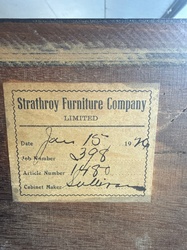
My appraisal is limited by the visual nature of the assessment. To fully authenticate the wood species, confirm construction methods (like dovetails), and assess any restorations or hidden damages, an in-person examination would be crucial. Furthermore, the absence of discernible maker's marks prevents specific attribution, which typically requires a physical inspection. Provenance documentation, if available, would further enhance certainty regarding age and origin.