Photo and notes provided by the user — not generated by AI
Submitted photo · May 27, 2026
User's notes
No additional notes provided.
AI analysis below
AI appraisal
AI analysis & estimate
AI-Generated · Verify before acting
Everything below is generated by AI for informational purposes only. AI can make mistakes — the AI may misidentify items or misattribute them (artist, maker, brand, designer, origin, era). This is not an official valuation and should not be used for insurance, sale, tax, estate, legal, or lending purposes — or any decision requiring a certified appraisal. It is not an authoritative claim about any person, brand, or rights holder — do not share or rely on it as a factual statement about a third party. Always consult qualified professionals before making financial decisions.
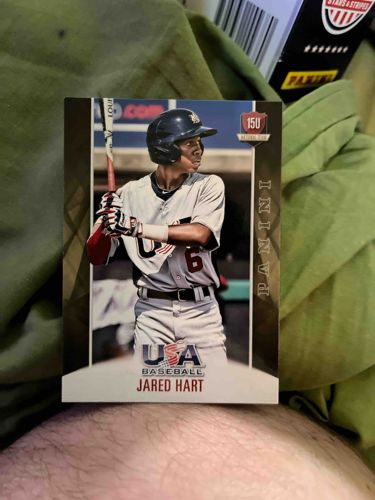
This item is a modern sports trading card, specifically a baseball card featuring player Jared Hart. The card is rectangular, approximately standard trading card size (roughly 2.5 x 3.5 inches), and appears to be made of standard card stock with a glossy finish on the front. The primary image on the card shows Jared Hart in a batting stance, wearing a grey USA Baseball uniform with the number '6' visible on his chest. He is holding a wooden baseball bat. The background is a blurred image of a baseball field.
Notable features include the 'USA Baseball' logo prominently displayed at the bottom center of the card. Below this logo, the name 'JARED HART' is printed in black uppercase letters. The right side of the card features a vertical strip with a dark brown or bronze color, on which the word 'PANINI' is printed vertically, indicating the manufacturer. Near the top right of this strip, there's a small red rectangular emblem with '150' on it, possibly indicating a special edition, anniversary, or a numbered parallel. The overall design features a white border at the bottom and a dark brown/bronze border on the sides and top wrapping around the central image.
Based on visible branding ('PANINI', 'USA Baseball') and the modern photographic style, this card is from a contemporary production run, likely within the last 10-15 years. The visible condition appears excellent, with sharp corners and no obvious creases, tears, or surface wear from the front view. The colors are vibrant, and the print quality is high, suggesting good craftsmanship typical of major trading card manufacturers. The card's aesthetic is clean and professional, designed for collectors of baseball cards and USA Baseball memorabilia. The rear of the card is not visible, but would typically contain player statistics, biographical information, and card numbering.
AI Appraisal Report
·AI can make mistakes·Verify before acting
Upon visual examination of the provided image, I assess this Jared Hart USA Baseball Panini Trading Card to be in excellent condition. Corners appear sharp, and there are no visible creases, tears, or surface abrasions. The colors are vibrant, and the print quality is high, consistent with a well-preserved modern card. Authenticity, based solely on this image, appears strong given the recognizable Panini branding and professional design. However, it is crucial to note that full authenticity verification would require in-person examination to assess card stock, printing anomalies, and potential alterations not visible in a 2D image.
Market conditions for current prospect cards like this typically fluctuate based on a player's performance and eventual MLB career. Jared Hart is not currently a widely recognized star, which limits broad market demand compared to established veterans or top-tier prospects. Rarity consideration is based on the '150' emblem, which hints at a possible parallel or numbered print run. If this signifies a low serial number (e.g., /150 or less), it would add to the card's rarity and value. Without knowing the exact set, parallels, or specific numbering, its rarity cannot be fully determined from the image alone.
Factors significantly impacting value include Hart's future success, the scarcity of this particular parallel, and confirming it is not a common base card.
Limitations in authenticity verification from images alone are significant. A physical inspection would allow for tactile assessment of card thickness, surface texture, and microscopic examination for print defects or alterations. Provenance documentation (e.g., original pack pulls, certified autograph documentation if applicable) would further secure authenticity. Scientific testing, like UV light examination, could reveal tampering or non-authentic materials.