These notes were written by the person who submitted this item. Appraiser.AI has not verified them, and the AI's identification and estimate may rely on them.
AI Estimated Value
Not an official valuation
$40-75
AI estimate as of August 5, 2025 · verify with a professional before acting
AI-Generated · Verify before acting
Everything on this page is generated by AI for informational purposes only. AI can make mistakes — the AI may misidentify items or misattribute them (artist, maker, brand, designer, origin, era). This is not an official valuation and should not be used for insurance, sale, tax, estate, legal, or lending purposes — or any decision requiring a certified appraisal. It is not an authoritative claim about any person, brand, or rights holder — do not share or rely on it as a factual statement about a third party. Always consult qualified professionals before making financial decisions.
This analysis also relies on unverified notes provided by the user, which may be incomplete or inaccurate and could affect the result.
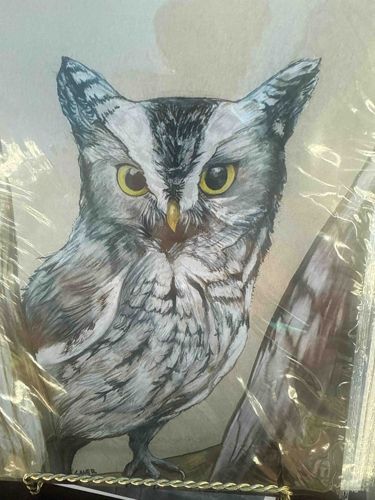
This item is an 8x10 inch print of a colored pencil artwork, likely depicting a Northern Saw-whet Owl given its size and distinct facial features, particularly the large head, large yellow eyes, and lack of ear tufts, along with the streaked breast and dark markings around the eyes outlined in white. The artwork is rendered in a realistic, delicate style, characteristic of colored pencil work, with visible fine lines and layering to create texture, especially in the feathers. The predominant colors are grayscale for the owl's plumage, featuring shades of white, grey, and black, with striking bright yellow eyes and a yellow beak that provide a vibrant contrast. The background appears to be a muted, light beige or cream color, possibly suggesting a natural environment. The owl is depicted perched on what appears to be a dark branch or similar natural element. The print is currently housed in a clear plastic sleeve, which is visible in the image, causing some glare and reflections, particularly on the right side and bottom left. This suggest it is being displayed for sale or protected for transport. The overall condition of the print underneath the plastic appears good, with no immediately visible creases, tears, or significant discoloration. There is a small, dark signature 'L. MEB' or 'L. MFB' on the bottom left, indicating the artist's initials. The style suggests it could be a contemporary piece, likely created in the 21st century due to the medium and realistic detailed approach common in modern wildlife art. The craftsmanship appears to be of good quality, showcasing attention to detail in the rendering of the bird's feathers and expressive eyes.
AI Appraisal Report
Upon examining the provided image of the 'Northern Saw-whet Owl Colored Pencil Art Print', I assess its condition to be excellent, observing no visible creases, tears, or significant discoloration beneath the clear plastic sleeve. The plastic itself introduces glare, but the print quality appears to be preserved. Authenticity, based solely on this visual, points to a print of a colored pencil artwork, as described. The visible signature 'L. MEB' or 'L. MFB' suggests artist identification; however, without direct comparison to known authentic signatures or a physical examination, full authentication of the artist or the print's originality (e.g., whether it's a limited edition or open edition print) is limited to the provided image.
Market conditions for contemporary wildlife art prints, particularly those with realistic and intricate detail, show a steady but niche demand. Comparables for 8x10 inch colored pencil prints by emerging or lesser-known artists typically range from $25 to $75. Factors influencing value include the artist's reputation, the print's edition size (if limited), and the perceived quality. This piece exhibits good craftsmanship and artistic skill, making it appealing to wildlife art collectors. The owl as a subject is generally popular. Rarity is difficult to ascertain without knowledge of the edition.
Limitations in authenticity verification from images alone are significant. A physical inspection would allow me to determine the exact print quality, paper type, and whether it's an giclée or other type of print. Provenance documentation (e.g., certificate of authenticity, artist's direct sale records) would be crucial for verifying the artist and edition details. Scientific testing is not typically required for contemporary prints unless there are specific concerns about forgery, which are not apparent here.