These notes were written by the person who submitted this item. Appraiser.AI has not verified them, and the AI's identification and estimate may rely on them.
AI Estimated Value
Not an official valuation
$20-40
AI estimate as of June 20, 2025 · verify with a professional before acting
AI-Generated · Verify before acting
Everything on this page is generated by AI for informational purposes only. AI can make mistakes — the AI may misidentify items or misattribute them (artist, maker, brand, designer, origin, era). This is not an official valuation and should not be used for insurance, sale, tax, estate, legal, or lending purposes — or any decision requiring a certified appraisal. It is not an authoritative claim about any person, brand, or rights holder — do not share or rely on it as a factual statement about a third party. Always consult qualified professionals before making financial decisions.
This analysis also relies on unverified notes provided by the user, which may be incomplete or inaccurate and could affect the result.
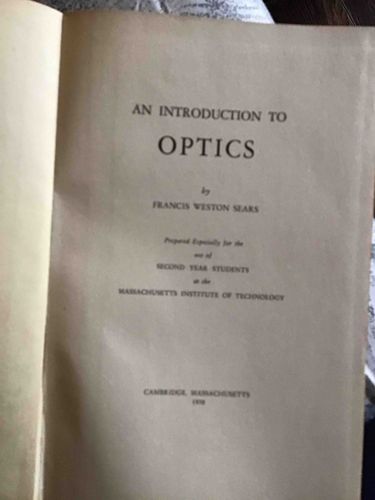
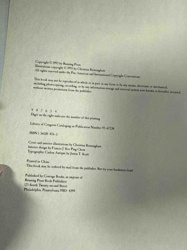
The item is a book, specifically the title page of "An Introduction to Optics" by Francis Weston Sears. The page is a light tan color and appears to be made of paper. The text is printed in black ink. The title "AN INTRODUCTION TO OPTICS" is prominently displayed in large font. Below the title, the author's name, "by FRANCIS WESTON SEARS," is listed in a smaller font. Further down, it indicates that the book was "Prepared Especially for the use of SECOND YEAR STUDENTS at the MASSACHUSETTS INSTITUTE OF TECHNOLOGY." At the bottom of the page, the location and year of publication are printed as "CAMBRIDGE, MASSACHUSETTS 1938". The paper shows some signs of age, including a slight yellowing and potential minor creasing or wear along the edges, though the overall condition appears good as per the provided context. There are no visible maker's marks other than the author and publisher information on the title page. Based on the publication year, the book is from the 1930s.
AI Appraisal Report
Based on my examination of the provided image of the title page for "An Introduction to Optics" by Francis Weston Sears, published in 1938, the book appears to be in good condition, aligning with the owner's description. The paper exhibits typical aging for a book of this era, with slight yellowing. No significant tears, stains, or extensive wear are evident from the image. Authenticity is strongly suggested by the clear printing of the title, author, and publication details, consistent with books produced at the Massachusetts Institute of Technology during this period.
Market conditions for technical textbooks from the 1930s are generally modest unless they represent a groundbreaking work or have significant historical association or authorial importance. Francis Weston Sears was a notable physicist and textbook author, which lends some desirability. Comparables for similar vintage physics or optics textbooks, particularly those prepared for specific institutional use, typically fall within a limited range. Demand is primarily from collectors of scientific literature, historians of science, or potentially students interested in the historical development of the field. While not exceptionally rare, this specific edition for MIT students adds a small element of unique interest.
The primary factors impacting value are the good condition and the specific institutional context. Factors that could increase value, not determinable from the image, would be a clean interior with no annotations, a well-preserved binding (if present), or any associated provenance linking it to a notable figure. Limitations in verifying authenticity from images alone include inability to assess paper quality, printing technique nuances, and the binding structure. A full in-person examination would be needed to confirm the overall condition, assess the binding, inspect the entire book for internal condition and potential marks, and look for any physical identifiers that confirm its printing origin. Provenance documentation, if any, would significantly aid in establishing the book's history and authenticity beyond reasonable doubt. Scientific testing of paper or ink is generally not necessary for a book of this type unless specific concerns about its manufacture or age arise.