AI estimate as of September 17, 2025 · verify with a professional before acting
AI-Generated · Verify before acting
Everything on this page is generated by AI for informational purposes only. AI can make mistakes — the AI may misidentify items or misattribute them (artist, maker, brand, designer, origin, era). This is not an official valuation and should not be used for insurance, sale, tax, estate, legal, or lending purposes — or any decision requiring a certified appraisal. It is not an authoritative claim about any person, brand, or rights holder — do not share or rely on it as a factual statement about a third party. Always consult qualified professionals before making financial decisions.
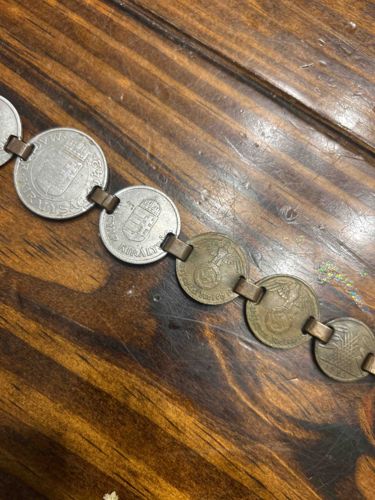
This item is a coin bracelet, seemingly constructed from a series of historical coins linked together with metal findings. The observable section of the bracelet shows at least six distinct coins. The coins on the left appear to be made of a lighter, silvery-toned metal, possibly aluminum or a base metal alloy, while those on the right exhibit a darker, coppery or bronze hue, suggesting different metallic compositions. Close inspection reveals that at least two of the lighter-toned coins are Hungarian. One clearly displays the word "KIRÁLYSÁG" and a Hungarian coat of arms, likely indicating a coin from the Kingdom of Hungary. Another lighter coin also shows a similar design element. The darker coins to the right, though less distinct, appear to have imagery consistent with German coinage from the Nazi era, specifically showing an eagle clutching a swastika, which is characteristic of Reichspfennig or similar denominations from that period. The coins are linked by small, rectangular or oval-shaped metal findings, possibly copper or brass given their color. These linkages are positioned at two points along the edge of each coin, creating a flexible, interconnected chain. The overall condition of the coins varies; some show significant wear and oxidation, particularly the darker coins, which also display a heavy patina. The lighter coins appear to be in slightly better, though still circulated, condition. No clear maker's marks or signatures are visible on the linking elements. The bracelet appears to be a folk art or commemorative piece, likely assembled in the mid-20th century, given the apparent age of the coins, particularly the German ones. The craftsmanship seems utilitarian, focusing on linking the coins securely rather than intricate design. The mix of Hungarian and German coins across what appears to be a continuous piece suggests a possible connection to a specific historical period or a collection of convenience.
AI Appraisal Report
I have examined the provided image of this coin bracelet, which appears to be a folk art piece incorporating Hungarian and German coinage. The condition of the coins varies, with the lighter Hungarian coins appearing circulated but in slightly better shape than the darker German coins, which show significant wear, oxidation, and heavy patina. Based on the visible iconography, especially the eagle clutching a swastika on the darker coins, these appear to be genuine German Reichspfennig or similar denominations from the Nazi era (1933-1945). The Hungarian coins with 'KIRÁLYSÁG' and a Hungarian coat of arms are consistent with coinage from the Kingdom of Hungary, likely mid-20th century. The authenticity of the individual coins themselves appears credible from the visual evidence, but physical examination would be necessary to confirm metallic composition, exact dates, and mint marks. The linking elements are utilitarian and appear consistent with amateur or small-scale craftsmanship, likely copper or brass.
Market conditions for such coin bracelets are generally driven by their historical novelty rather than numismatic value, as most coins used in these pieces are common issues. The presence of Nazi-era German coins can be polarizing; some collectors seek these items for historical interest, while others avoid them. Demand is niche; while individual coins might fetch a few dollars, the assemblage doesn't significantly multiply that value unless exceptionally rare or historically significant coins are used. Factors impacting value include the condition of the coins, the specific denominations and dates (which are not fully discernible here), and the overall craftsmanship of the bracelet. Without physical examination, I cannot definitively verify the authenticity of the coins beyond their visual representation, nor can I assess the durability or material quality of the linking elements. Detailed provenance documentation would also clarify the bracelet's origin. Given the common nature of the apparent coins, the value lies more in its unique assembly as a historical artifact than in its precious metal content or rarity as individual coins.