AI estimate as of June 9, 2025 · verify with a professional before acting
AI-Generated · Verify before acting
Everything on this page is generated by AI for informational purposes only. AI can make mistakes — the AI may misidentify items or misattribute them (artist, maker, brand, designer, origin, era). This is not an official valuation and should not be used for insurance, sale, tax, estate, legal, or lending purposes — or any decision requiring a certified appraisal. It is not an authoritative claim about any person, brand, or rights holder — do not share or rely on it as a factual statement about a third party. Always consult qualified professionals before making financial decisions.
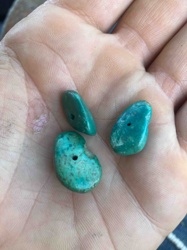
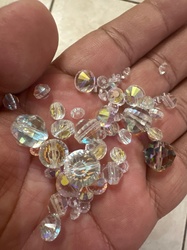
Three irregular-shaped, tumbled turquoise beads are presented in the open palm of a hand. Each bead varies in size and shape, exhibiting the natural, organic form of tumbled stones. They are a vibrant turquoise blue-green color with visible matrix, appearing as darker veins and inclusions throughout the stones. There is some surface variation and likely minor pitting consistent with natural turquoise and the tumbling process. A single, centrally located hole is drilled through each bead, presumably for stringing or mounting. The drilling appears to be somewhat rough and not perfectly centered on all beads, suggesting a more rustic or perhaps older craftsmanship. The hand holding the beads appears worn, with visible lines and a small area of pink skin irritation, providing scale and context but no additional information about the beads themselves. There are no visible manufacturing marks, signatures, or stamps. Based on the appearance, these could be vintage or antique beads, possibly originating from the Southwestern United States or another area known for turquoise mining. The quality appears to be natural, untreated turquoise, with visible imperfections that add to their unique character.
AI Appraisal Report
I have examined the provided image of three tumbled turquoise beads. These beads appear to be natural turquoise, exhibiting the characteristic blue-green coloration and visible matrix. Their irregular shapes are consistent with tumbled stones. The surface shows minor variations and potential pitting, which is expected in natural, untreated turquoise subjected to tumbling. The drilling of the holes is somewhat rough and not perfectly centered on each bead, suggesting a more rustic or possibly older craftsmanship. Based solely on visual examination of the image, these appear to be genuine turquoise. The lack of visible manufacturing marks or stamps aligns with natural beads. The quality appears to be natural, likely untreated,turquoise. Market conditions for natural turquoise beads vary significantly based on origin, quality, matrix presence, and historical context. Without physical examination, it is difficult to definitively assess the origin, age, or specific type of turquoise, which directly impacts value. These beads are appealing due to their natural form and color, and there is a consistent demand for genuine turquoise in the market, particularly within gemstone and jewelry circles. Factors impacting value include the authenticity of the turquoise (whether it's genuine, treated, or imitation), the precise origin (e.g., specific mines known for high-quality turquoise), and the age and provenance if they are indeed vintage or antique. To fully authenticate and determine the precise value, in-person examination is crucial to assess weight, feel, and internal characteristics not visible in an image. Spectroscopic analysis or other gemological testing would confirm whether it is natural turquoise and rule out treatments or imitations. Provenance documentation, if available, would provide context regarding age and origin, significantly impacting value if they are historically significant or from a renowned mine.