AI estimate as of August 28, 2025 · verify with a professional before acting
AI-Generated · Verify before acting
Everything on this page is generated by AI for informational purposes only. AI can make mistakes — the AI may misidentify items or misattribute them (artist, maker, brand, designer, origin, era). This is not an official valuation and should not be used for insurance, sale, tax, estate, legal, or lending purposes — or any decision requiring a certified appraisal. It is not an authoritative claim about any person, brand, or rights holder — do not share or rely on it as a factual statement about a third party. Always consult qualified professionals before making financial decisions.
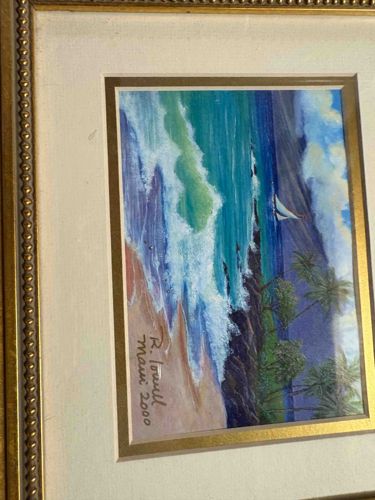
This item is a framed miniature painting or print depicting a vibrant coastal scene. The artwork features a sandy beach transitioning into an active ocean with significant waves crashing towards the shore. The colors used for the water are striking, ranging from deep blues in the distance to bright turquoises and a frothy white where the waves break, indicating motion and depth. On the right side of the composition, a dark, rocky coastline with lush green foliage, likely palm trees given the 'Maui' inscription, abuts the ocean. A small white sailboat is subtly visible in the calmer, distant waters, adding a point of interest. The painting appears to be signed vertically on the lower left, 'R. Lowell Maui 2000', indicating the artist, location, and year of creation. The medium appears to be an opaque pigment, possibly acrylic or gouache, applied with visible brushstrokes, especially in the rendering of the waves. The artwork is presented within a double-matting system. The inner mat is a thin, gold-colored border that directly frames the image, while the outer mat is a wider, off-white or cream-colored board, providing ample visual space around the miniature. This entire assembly is housed within a substantial gold-toned frame. The frame features a classic, possibly egg-and-dart or bead-and-reel, pattern along its inner edge, giving it a traditional and decorative appearance. The visible condition of the frame and matting appears good, with no obvious signs of significant damage, though slight dust or minor scuffs might be present from age and handling. The overall presentation suggests a decorative piece, likely intended for display in a home or office.
AI Appraisal Report
Upon visual examination of this R. Lowell 'Maui 2000' Seascape Painting, I assess its condition as very good for a piece of its presumed age. The colors appear vibrant with no obvious fading, and the integrity of the matting and frame seems well-preserved, though minor dust or scuffs are possible without in-person inspection. Authenticity, based solely on the visible signature 'R. Lowell Maui 2000', appears consistent with a piece created by an artist for decorative purposes. However, without direct inspection, I cannot verify the signature's application (e.g., printed vs. hand-signed) or the artwork's medium definitively. It appears to be an opaque pigment, possibly acrylics or gouache, but could also be a high-quality print.
Market conditions for decorative seascape paintings, especially miniatures by lesser-known artists, are steady but not high. Demand exists for charming, well-presented pieces that fit an aesthetic. Rarity is not a significant factor here; 'R. Lowell' does not appear to be a widely collected artist with established auction records. The primary value drivers are its attractive presentation, good condition, and the 'Maui' inscription, which adds a desirable thematic element for collectors of island-inspired art or souvenirs. If this is an original painting, a slight premium applies over a print. Without provenance documentation or a direct physical examination to confirm it's an original painting and not a print, and to assess the specific quality of the artist's work, the valuation remains conservative.
For full authentication, a physical examination would be crucial to determine the medium and original hand-painted nature versus a reproduction. Scientific testing could further confirm pigment composition and age if necessary. Provenance documentation (e.g., purchase receipts, artist's certificate) would also greatly solidify authenticity and potentially increase value.